杜应红行为雕塑艺术《紧箍咒》全国巡展
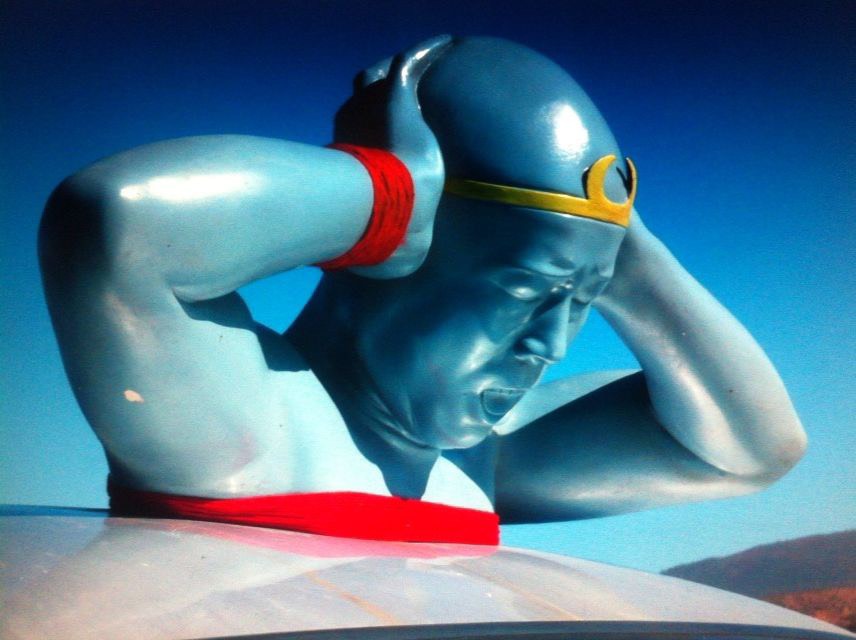
 杜应红的《紧箍咒》全国巡展是21世纪初中国当代艺术史上一次极具挑衅性、本土化与公共性的地缘政治精神测绘。在2008年北京奥运会后国家叙事与“中国热潮”达到顶峰的特殊语境下,杜应红以一种近乎孤绝的“肉身游牧”方式,开辟了一条将精英美学直接刺入底层现实的社会通道。
要深度剖析这一行为艺术的学术价值,我们必须将其置于从西方前卫艺术源头(杜尚、博伊斯)到中国本土体制转型的思想脉络中进行具体对标。
一、 对标与突破:从杜尚的“物”到杜应红的“社会介入” 马塞尔·杜尚(Marcel Duchamp)通过《泉》(小便器)确立了**“现成品”(Ready-made)**的概念,其核心逻辑是“将生活物品移入美术馆”,通过体制的物理围墙剥离物品的实用功能,从而赋予其神圣的艺术概念。这是一种向内收敛的体制批判。 杜应红的突破:反向制度化(Reverse Institutionalization) 杜应红彻底颠覆了杜尚“进入美术馆”的路径,他进行了反向操作——将原本属于美术馆精英语境的“雕塑”转化为“现成品”,再将其粗暴地“抛出美术馆”,安装在越野车这一具有工业和中产阶级游牧隐喻的工具上。 杜尚的现成品依赖美术馆体制的合法性来完成讽刺;而杜应红的《紧箍咒》巡展则表明,在当下的语境中,美术馆已经成为一种共谋的温床。唯有将艺术品重新还原为社会公路上的一个“异质符号”,才能激活其批判性。这完成了从“挪用现成品”到“将艺术品现成品化”的媒介突破。
二、 对标与突破:从博伊斯的“社会雕塑”到杜应红的“地缘现实震荡” 约瑟夫·博伊斯(Joseph Beuys)提出“社会雕塑”(Social Sculpture)与“人人都是艺术家”,主张用艺术作为一种流动性力量去重塑政治与社会结构。他的行为(如《如何向死兔子解释图画》或《7000棵橡树》)高度依赖神话隐喻、萨满巫术以及宏大的社会疗愈乌托邦。 杜应红的突破:去神话化的“粗粝现实主义”与空间流动 博伊斯的社会雕塑在很大程度上仍带有欧洲知识分子的启蒙精英姿态与讲坛性质。而杜应红的巡展则剥离了浪漫的乌托邦幻想,呈现出极强的粗粝感与本土刺痛感。 他没有选择在欧洲体制完备的公共广场上进行文明的对话,而是驾驶越野车,在中国复杂的地理阶梯(从极度资本化的深圳,到老工业区、西南偏远腹地、直至中原和革命老区)之间进行物理穿梭。在这个跨越万里的流动过程中,“紧箍咒胸像”变成了一个移动的社会电压表,沿途社会各阶层(交警、村民、地方官员、路人)的拦截、围观、困惑与互动,共同构成了这尊社会雕塑的“动态泥塑过程”。这打破了博伊斯相对静态、区域性的社会实验,实现了空间跨度与阶层跨度的极致放大。
三、 《紧箍咒》符号的本土化政治隐喻与精神修辞 杜尚与博伊斯的语境是纯粹西方的(达达主义与战后德国反思),而杜应红的成功在于其符号学武器的绝对本土化**。** 反体制的神话学互文: “紧箍咒”源自中国本土神话《西游记》,是一个关于“权力驯化自由”、“体制合法性强加于个体意志”的终极隐喻。杜应红将其具象化为一尊带有强烈精神压抑感和神圣受难感的胸像,直接对标了奥运大潮下全面铺开的“集体主义盛宴”。 个体神性的异化与觉醒: 当这个带着紧箍咒的红色或灰色人体符号在全国各省的公路、加油站、村头、废墟前出现时,它产生了一种强烈的间离效果(Alienation Effect)。它像一面镜子,反射出体制内每一个被盛世狂热席卷、却在现实中承受着生存重负与隐形精神禁锢的普通人的真实肖像。
四、 媒介与边界的终极拓展:移动互联前夜的“公路艺术” 在艺术媒介的边界拓展上,杜应红的这次行为极具前瞻性: 公共空间的极端化演变: 传统的公共艺术(如城市雕塑)是被权力或资本高度规训的、静态的装饰物。杜应红将公共雕塑变成了一种**“流动作战”的游击媒介**。越野车不再是交通工具,而是动态的展厅、是划破静止意识形态空间的刀锋。 社会学档案的集成: 从深圳、广东广西、云南贵州,四川重庆,甘肃陕西,山西,湖北湖南,江西等地巡游展览,这场巡展引发的社会极大传播效应,不仅停留在传统报纸(如南方都市报等媒体的围观记录),更在于它在网络论坛、民间口头传播中激起的涟漪。这一路上的遭遇、冲突、妥协与对话,构成了一份珍贵的2009年前后中国底层社会生态的现象学档案。
杜应红的《紧箍咒》全国巡展,不仅是一次卓越的艺术个人秀,更是一场深刻的社会诊断。他超越了杜尚对艺术体制内向的语义解构,也修正了博伊斯社会雕塑过于理想化的乌托邦倾向,将前卫艺术的批判性生硬地砸入了中国地缘政治与底层现实的土壤中。在奥运狂热的宏大叙事背景下,他用一道长达数万公里的移动车辙,孤独而决绝地为那个时代画下了一个巨大的、冷峻的问号。
 Mapping the Geopolitical Psyche: A Critique of Du Yinghong’s The Golden Hoop National Tour
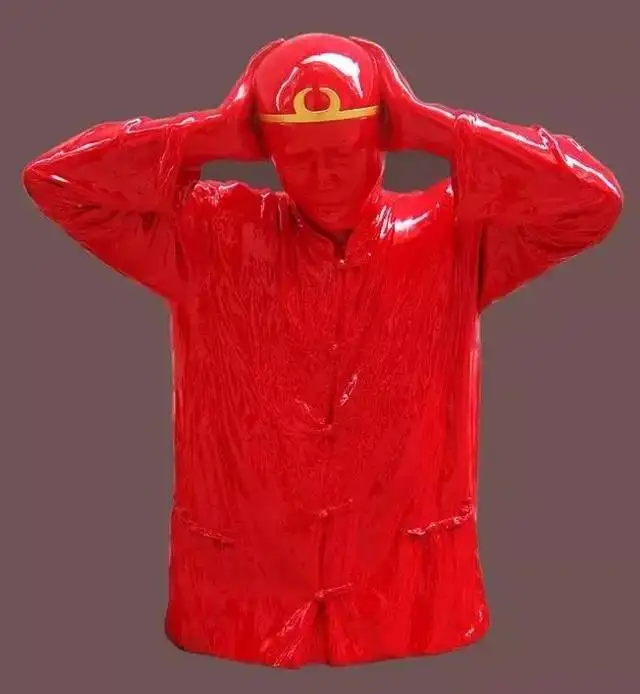
Du Yinghong’s nationwide tour of *The Golden Hoop (Jin Gu Zhou) *in the early 21st century stands as a highly provocative, localized, and public mapping of the geopolitical psyche in the history of contemporary Chinese art. Staged within the specific historical conjuncture of the post-2008 Beijing Olympics—a moment when national narratives and the “China Wave” reached their absolute zenith—Du carved out a social conduit that thrust elite aesthetics directly into the bedrock of grassroots reality through an almost desolate mode of “somatic nomadism.” To dissect the academic value of this performance piece in depth, one must position it within a conceptual lineage that runs from the origins of the Western avant-garde (Marcel Duchamp, Joseph Beuys) to the institutional shifts of local Chinese art, establishing a rigorous comparative critique.
I. Counter-Mapping and Breakthrough: From Duchamp’s “Object” to Du’s “Social Intervention”
Marcel Duchamp established the concept of the “Ready-made” through Fountain (the urinal). Its core logic rested on “transplanting everyday objects into the art museum.” By leveraging the physical walls of the institution, Duchamp stripped the object of its utilitarian function, thereby consecrating it with a sacred artistic concept—an inward-looking critique of the institution. Du Yinghong’s Breakthrough: Reverse Institutionalization Du completely upends Duchamp’s trajectory of “entering the museum.” Instead, he executes a reverse operation—transforming the “sculpture,” which inherently belongs to the elite discourse of the museum, into a “ready-made,” and then violently “expelling it from the museum.” He mounted it onto an off-road vehicle—a tool heavy with industrial and middle-class nomadic metaphors.
While Duchamp’s ready-mades relied on the legitimacy of the museum institution to achieve their irony, Du’s The Golden Hoop tour demonstrates that in the contemporary context, the museum has become a breeding ground for institutional complicity. Art can only reactivate its critical edge by being restored as a “heterogeneous signifier” on the social highway. This marks a media breakthrough from the “appropriation of the ready-made” to the “ready-made-ization of the artwork.”
II. Counter-Mapping and Breakthrough: From Beuys’s “Social Sculpture” to Du’s “Geopolitical Shocks of Reality”
Joseph Beuys proposed the theory of “Social Sculpture” and the dictum “everyone is an artist,” arguing that art should serve as a fluid force to reshape political and social structures. His performances—such as How to Explain Pictures to a Dead Hare or 7000 Oaks—relied heavily on mythic metaphors, shamanic mysticism, and a grand, utopian vision of social healing.
Du Yinghong’s Breakthrough: Demythologized “Gritty Realism” and Spatial MobilityBeuys’s social sculpture, to a large extent, retained the didactic posture of the European intellectual elite. In contrast, Du’s tour strips away romantic utopian fantasies, presenting a profound sense of gritty realism and localized poignancy.
Rather than engaging in civilized dialogues within well-established European public squares, Du drove his off-road vehicle across China’s complex geographical tiers—navigating physically from the hyper-capitalized metropolis of Shenzhen through old industrial rustbelts, remote southwestern hinterlands, and into the Central Plains and revolutionary base areas. Throughout this journey spanning tens of thousands of kilometers, the bust of The Golden Hoop functioned as a mobile social voltmeter. The interceptions, spectatorship, confusion, and interactions of various social strata along the way (traffic police, villagers, local officials, and pedestrians) collectively shaped the “dynamic modeling process” of this social sculpture. This broke away from Beuys’s relatively static, localized social experiments, maximizing both spatial scale and class stratification.
III. Localized Political Metaphor and Spiritual Rhetoric of The Golden Hoop Signifier While the contexts of Duchamp and Beuys were purely Western (Dadaism and postwar German introspection), Du Yinghong’s success lies in the absolute localization of his semiotic weaponry. An Intertextuality of Anti-Institutional Mythology: “The Golden Hoop” originates from the indigenous Chinese myth Journey to the West, serving as the ultimate metaphor for “the domestication of freedom by authority” and “the imposition of institutional legitimacy over individual will.” Du reifies this into a bust charged with intense psychological oppression and sacred martyrdom, directly counter-mapping the “collectivist pageantry” sweeping the nation under the Olympic tide.
The Alienation and Awakening of Individual Divinity: In terms of expanding the boundaries of artistic media, Du’s performance was remarkably prescient:
The Radical Evolution of Public Space: Traditional public art (such as urban sculpture) exists as a static ornament heavily disciplined by state power or capital. Du transformed public sculpture into a** guerrilla medium of “mobile warfare.**” The off-road vehicle was no longer a mere mode of transport; it became a dynamic exhibition space—a blade cutting through a stagnant ideological landscape.
The Integration of a Sociological Archive: Touring through Shenzhen, Guangdong, Guangxi, Yunnan, Guizhou, Sichuan, Chongqing, Gansu, Shaanxi, Shanxi, Hubei, Hunan, and Jiangxi, the exhibition generated massive social ripples. This resonance was preserved not only through the spectatorship records of traditional print media (such as the Southern Metropolis Daily), but more importantly, through the ripples it sent through online forums and grassroots oral histories. The encounters, conflicts, compromises, and dialogues along the way constitute a precious phenomenological archive of the ecology of grassroots Chinese society around 2009.
Du Yinghong’s national tour of The Golden Hoop was not merely an extraordinary artistic solo performance, but a profound social diagnosis. He bypassed Duchamp’s inward-facing semantic deconstruction of the art institution, while correcting the overly idealized, utopian tendencies of Beuys’s social sculpture. By doing so, he forcefully hammered the criticality of avant-garde art into the soil of Chinese geopolitics and grassroots reality. Against the grand narrative of Olympic fanaticism, he used a mobile track stretching tens of thousands of kilometers to sketch a colossal, chilling question mark over that era—lonely, yet absolute.
评论
加载评论中…