Sunlight Piercing the Veil, Achieving an Artistic Dream: An Interview with Celebrated Shenzhen Artist Du Yinghong
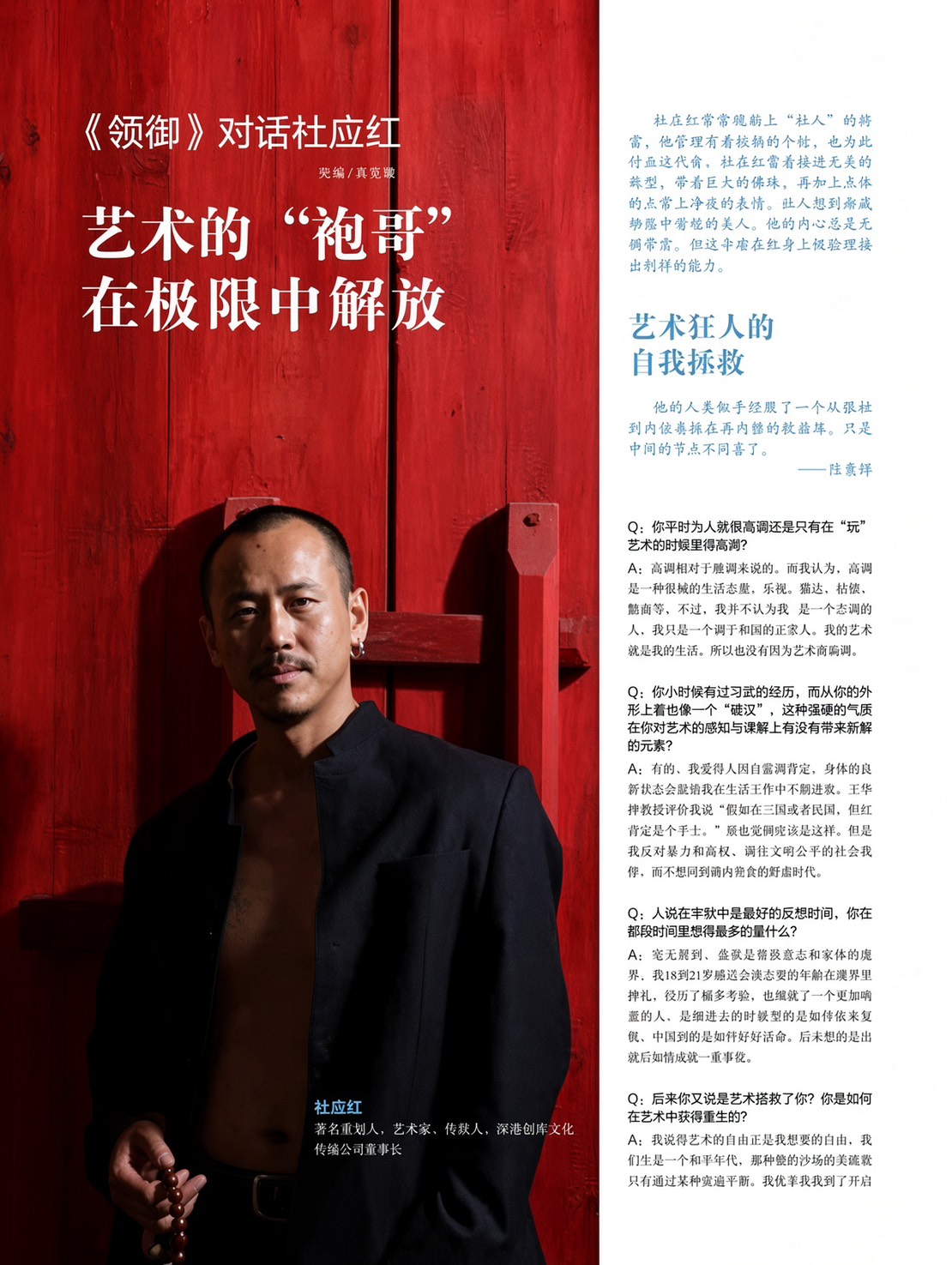
Shenzhen Press Group By Wu Weijuan
His precocious artistic talent seemed entirely self-taught, yet his burning creative ambitions were once severely obstructed by the reckless impetuosity of his youth. When he set forth once again to chase his dreams, would an unforgiving society offer a second chance to a man with a six-year prison record? A dark history stamped with the unique scars of that era might have cast a lifelong shadow over an ordinary soul. Yet, armed with a radiant spirit and an enduring dream, he held an unwavering faith in both himself and society. Through an act of sheer, isolated courage along his creative crusade, he ultimately and paradoxically knocked open the gates of the highest artistic sanctuaries.
Today, he traverses the grand avenue of cultural entrepreneurship as a multifaceted master—a vanguard artist, media tycoon, impresario, and radical art activist. The explosive energy of his cross-disciplinary practice has given birth to the “Shengang Art Depot” (Deep-Hong Kong Art Warehouse) and over ten sub-brands under its umbrella, including Shenzhen Art Web, Shenzhen Art Creation Base, Shenzhen Art Salon, Jiangmen Club, and Blue Wind Art Space. Having captured the imagination of the southern Chinese art world, he has been hailed by mainstream media and the public alike as the “Art Fanatic” and the “Unofficial Chairman of the Shenzhen Federation of Literary and Art Circles.“Du Yinghong: an artist whose soul has been purified by fire, and a historical disruptor possessing the sharpest cultural refinement.
I. A Prodigy Reborn from Ashes
In 1976, Du Yinghong was born in Zunyi, Guizhou Province. This land not only birthed the world-renowned Maotai liquor but also serves as a historic totem of modern Chinese political history due to the momentous “Zunyi Conference” of 1935. Growing up in an ordinary farming family, Du demonstrated an astonishingly innate artistic gift from early childhood. However, during his untamed and rebellious youth, he failed to conform to the rigid confines of institutional schooling. Dropping out before completing middle school, he drifted through the streets, carving chops and writing calligraphy couplets just to survive. At the age of 17, this wild, unbridled youth paid a heavy price—he was sentenced to prison for assault and robbery.
The loss of physical freedom behind iron bars marked the true awakening of Du Yinghong’s life and the unchaining of his spirit. Throughout those six agonizing years within the high walls, moved by the reformation officers and fellow inmates, his heart quickened under strict discipline, and his thoughts were cleansed. Through countless nights, he repented for his youthful recklessness and lay awake sketching grand blueprints for his post-incarceration resurrection. Crucially, he never ceased his grueling, near-ascetic practice of art, accumulating the core energy required for his future crusade. “I must become a person of value and meaning, and I must bring strength and encouragement to those who cared for and helped me inside,” he vowed silently upon his release.
At the turn of the century, the 24-year-old Du Yinghong re-entered society and immediately launched a magnificent life experiment. In his very first month of freedom, he walked every street and alleyway of Zunyi, meticulously documenting the structural and visual defects of commercial storefront signs and the city’s public aesthetics. He compiled these findings into a detailed Feasibility Proposal for the Upgrading of Zunyi’s Urban Aesthetics and submitted it directly to Li Zaiyong, the district party secretary at the time (Note: Li later rose to become the Vice Governor of Guizhou Province, only to fall from grace and face imprisonment himself years later). Although the proposal was shelved due to its colossal scale, this initial setback failed to crush Du. Subsequently, during interviews for positions as a security guard, bodyguard, or commercial artist, he never concealed his criminal record. Yet, the shallow and prejudiced social environment of that period offered little encouragement for his raw honesty.
The suffocating provincial narrowness of his hometown prompted Du to cast his gaze decisively toward the South. He suddenly remembered Shenzhen—the city that had brushed past him in 1992. As a 17-year-old without a temporary residence permit, he had been blocked outside the Buji Checkpoint, left only to gaze at the neon lights of the Special Economic Zone from the distant waters of Huiyang. Yet, his instinct told him that only Shenzhen—with its inclusive immigrant culture and its meritocratic environment that asked no questions of a man’s past—could harbor his exiled dreams and become the sacred ground to reshape his destiny.
In 2000, filled with infinite yearning for the future, Du Yinghong entered Shenzhen for the second time. Standing before the hyper-modern waves and prosperity of the Special Economic Zone, he felt a profound generational rupture: he did not know how to use a mobile phone, nor had he ever ridden a driver-operated public bus. To measure and integrate himself into this high-speed modern metropolis by sheer physical presence, he chose the most primitive method—he spent over a week walking dozens of kilometers from Buji to Overseas Chinese Town, using his eyes and feet to stubbornly decipher the modern textures of Shenzhen.
II. Pioneering Early Childhood Education: Rising to the Absolute Summit
Shenzhen proved true to its reputation: a frontier where “heroes are never judged by their origins.” It wiped clean the slates of Du Yinghong’s past triumphs and disgraces, allowing his life to completely reset. Void of discrimination and requiring no political connections, Du quickly secured a position in commercial advertising using his exceptional visual gifts. However, a twist of fate occurred on his way to report for duty—a recruitment notice for an art teacher from an educational institution scrolled across a massive outdoor screen in Huaqiangbei. Intrigued, he instantly abandoned his secured job and walked into the interview.
The interview hall was crowded with formidable competitors; the other 15 applicants were highly credentialed, university-trained professionals, while Du possessed neither a degree nor an orthodox pedigree. Faced with the practical test of “designing the window showcase poster for the kindergarten’s new semester,” Du experienced a flash of profound inspiration, seamlessly melding his calligraphy skills with his sculptural instincts. He carved iron-plated brush strokes onto foam blocks, creating pristine three-dimensional characters. This highly striking, original technique won the day. He was selected that very evening and assigned to the Fuyong Central Kindergarten, the largest institution of its kind in Shenzhen. On his third day of work, which happened to be payday, he received the 100 RMB he had earned. Du sprinted back to his dormitory, buried his face in a pillow, and wept—tears of sheer ecstasy for individual dignity that had finally been validated by society.
He was 24 years old. Society had finally embraced him with forgiveness, allowing him to step out from the psychological shackles of a dark history into a normal life. Adopting a relentless ethos of “doing whatever I do to absolute perfection,” Du worked passionately at his duties while voluntarily taking on extraneous tasks. His exceptional teaching methods won rave reviews from parents and administrators alike. Within three months, he was broken out of rank as an exemplary educator and named the head of the kindergarten’s art department. Within six months, he launched his first off-campus art training seminar, which achieved explosive success.
Du’s extraordinary performance sent shockwaves through the Shenzhen early childhood education community. The head of the Nanshan District Education Bureau personally intervened to recruit him as an urgently needed elite talent. In his new institution, he was given an independent studio, a dedicated computer, and a salary that quickly soared beyond 6,000 RMB a month—a figure that shattered industry benchmarks in the year 2000. In his teaching practice, he discarded traditional, dogmatic art instruction, pioneering a “synthetic situational pedagogy” that fused music, dance, painting, and calligraphy into a singular interactive experience, and compiled his own set of early childhood art textbooks. This vanguard methodology caused enrollment in his training classes to break one hundred, drawing institutions from across Shenzhen to observe and learn. Faced with surging demand, he resolutely resigned to dedicate himself entirely to pioneering independent art education.
In 2004, Du’s innovations caught the attention of national authorities. Under the editorial guidance of Liang Zhisen—the nation’s foremost early childhood education authority, Director of the Chinese Society for Early Childhood Education, and Professor at Beijing Normal University—Du authored an eight-volume series of supplementary national textbooks for early childhood art. Published by the China Children’s Publishing House, the series was distributed for uniform use across preschool institutions nationwide. Having taken early childhood art education to the nation’s absolute summit, Du offered a deeply ironic smile. He noted that according to the strict educational laws of the state, a person with a criminal record was technically barred from long-term teaching. Yet, the deeper truth was that having conquered the peak of education, his spirit was already flying toward a broader sky—to chase his lifelong dream of becoming a pure, fine artist.
III. The Art Master: A Cross-Media Methodological Breakthrough
The year 2004 marked the genesis of Du Yinghong’s pure artistic pursuit. Secluding himself in his studio, he spent days and nights exploring national ink painting and oil painting, developing a fiercely individualistic style that quickly earned him renown within contemporary art circles. Peers marveled at his near-masochistic work ethic and whispered of his legendary status in the educational world. When outsiders asked if he was an “academic fine arts graduate,” he would wittily reply, “I didn’t study art; I taught it.”
In truth, aside from an introduction by Beijing educational expert Ms. Cheng Yuying, which allowed him to seek long-distance guidance via telephone from the grandmaster Wu Guanzhong, Du never received formal training within a traditional art academy. Instead, sprawling library volumes, the surrounding political ecology, and the profound joys and sorrows of society constituted his richest nutrients. As he often stated, “The capacity for self-education and social awareness are the two most critical foundational abilities a human can possess.”
As his creative output flourished, Du’s exceptional organizational talents and public-spirited consciousness began to emerge. He acutely observed that while Shenzhen possessed a dense concentration of brilliant artists producing vanguard works, the city suffered from a total lack of platforms for public exhibition and articulation. When the Indian Ocean tsunami struck, Du galvanized the community, launching a charity exhibition of donated works that drew immediate responses from over a hundred artists. The success of this campaign made him realize that artistic public intervention must be institutionalized. Consequently, he registered and founded the Shenzhen-Hong Kong Art Depot Culture Communication Co., Ltd.
Transforming from a pure artist into an organizer of epic art movements, Du consecutively founded the “Shenzhen Artists’ Stronghold” and Shenzhen’s very first authentic art district—the “Shenzhen Art Creation Base.” This monumental feat catalyzed a revolutionary leap in Shenzhen’s cultural development. The Art Depot district not only hosted theme events twice a month without fail, but it also organized annual mass art movements bringing先锋 (vanguard) artists from across China to Shenzhen. It launched the “Anti-Airdrop” art campaign aimed at dismantling cultural monopolies and the “Made in Shenzhen” youth artist showcase, constructing an open platform for a vast generation of local talents to rise.
During those lean early years devoid of state or corporate funding, circles still pass down the tragic and heroic tale of Du Yinghong “selling his house to fund exhibitions.” In 2005, facing a catastrophic budget shortfall for the inaugural expo, Du withdrew his entire down payment for a personal apartment. He swiftly assembled 118 contemporary artists to launch the sensational “Art Supermarket Exhibition” at the Nanshan Book Mall Plaza. By building a free, open, open-air street market, he allowed high-brow contemporary art to face the public just like vegetables in a supermarket, offered for free viewing and affordable consumption. Because of its radical public participation, the China Academy of Art cataloged the exhibition in its scholarly texts as one of the two most “revolutionary exhibition case studies” in Chinese contemporary art history. After three consecutive iterations, this model was appropriated by commercial capital conglomerates, such as the Shanghai Super Ocean Group, paving the way for the world’s first physical art supermarkets.
IV. Media Flagships and the Sociological Intervention of the “Tightening-Crown” System
To date, Du Yinghong has successfully and independently curated over 150 highly influential public art exhibitions and performance activities, including “Contemporary Art Enters the Community,” “Home Art Museums,” “Shenzhen Kinetic Contemporary Art Exhibition,” and the “Shenzhen Art Salon.” He even initiated the “Urban Village Memory” artistic intervention project, utilizing photography and field research to deeply investigate the subaltern living conditions within Shenzhen’s urban villages, directly translating art into a deep sociological observation and political intervention.
To thoroughly shatter the historic trap where Chinese art passively accepted the propaganda of either the state or corporate capital, Du realized that art must possess its own sovereign media flagships. During the operation of the “Shengang Art Depot,” he launched its subsidiary, “Shenzhen Art Web.” Tasked with becoming the media flagship of Shenzhen’s cultural arts and constructing a spiritual home for Chinese citizens in a turbulent era, the platform established deep strategic partnerships with CCTV and China Entertainment Television (CETV). It rapidly rose to become one of the largest art portal clusters in the nation, earning the distinction of being named one of the “Top Ten Art Websites in China.” Following this, he founded* Deep-Hong Kong Ar*t magazine, Jiangxiang China magazine, and the Jiangxiang China website, beating the drums for the native articulation of contemporary art and establishing an indisputable industry media benchmark.
Simultaneously, he established the renowned “Jiangmen Club” art salon, forging it into a profound sanctuary for cross-disciplinary dialogue between the intellectual, artistic, and corporate elite. Concurrently with his creative output and public enterprises, Du was elected Executive President of the Shenzhen Art Research Association, appointed as a guest professor at multiple universities, and lauded by mainstream media as an “Art Fanatic” and the “Unofficial Chairman of the Shenzhen Federation of Literary and Art Circles.” Shenzhen Television once broadcast an exclusive profile on his legendary life titled* The Sunny Master: From Juvenile Offender to Art Fanatic.*
From his initial quest for basic survival, to his mid-career pursuit of ideals, and finally to his late-stage practice of historical missions and social responsibility, Du Yinghong stands as an exceptionally passionate, individualistic, and critically rational vanguard artist within the contemporary Chinese art scene. Deep within the recesses of the Jiangmen Club, he houses a vast collection of his self-created “Tightening-Crown” (Jinguzhou) series of sculptures and cross-media installations. These constitute not only the absolute zenith of his visual art but also serve as a decades-long political metaphor and visual resistance against ideological taming and state-enforced thought-control.
“Art knows no borders, but the spirit carries a rein.” As a leader and radical actionist of contemporary Chinese art, Du Yinghong has consistently used the high-voltage practice of his own flesh and his cross-media methodology to combat the brainwashing incantations and ideological shackles of the era. He has used his life to prove to the world that light will ultimately pierce the iron curtain of systems and the shadows of history. That crimson sculpture wearing a golden tightening hoop will forever stand upon the fault lines of history, passionately transmitting an unyielding humanistic energy for the spiritual liberation and awakening of the individual conscience!
评论
加载评论中…