《领御》杂志对话杜应红艺术的袍哥——在极限中解放
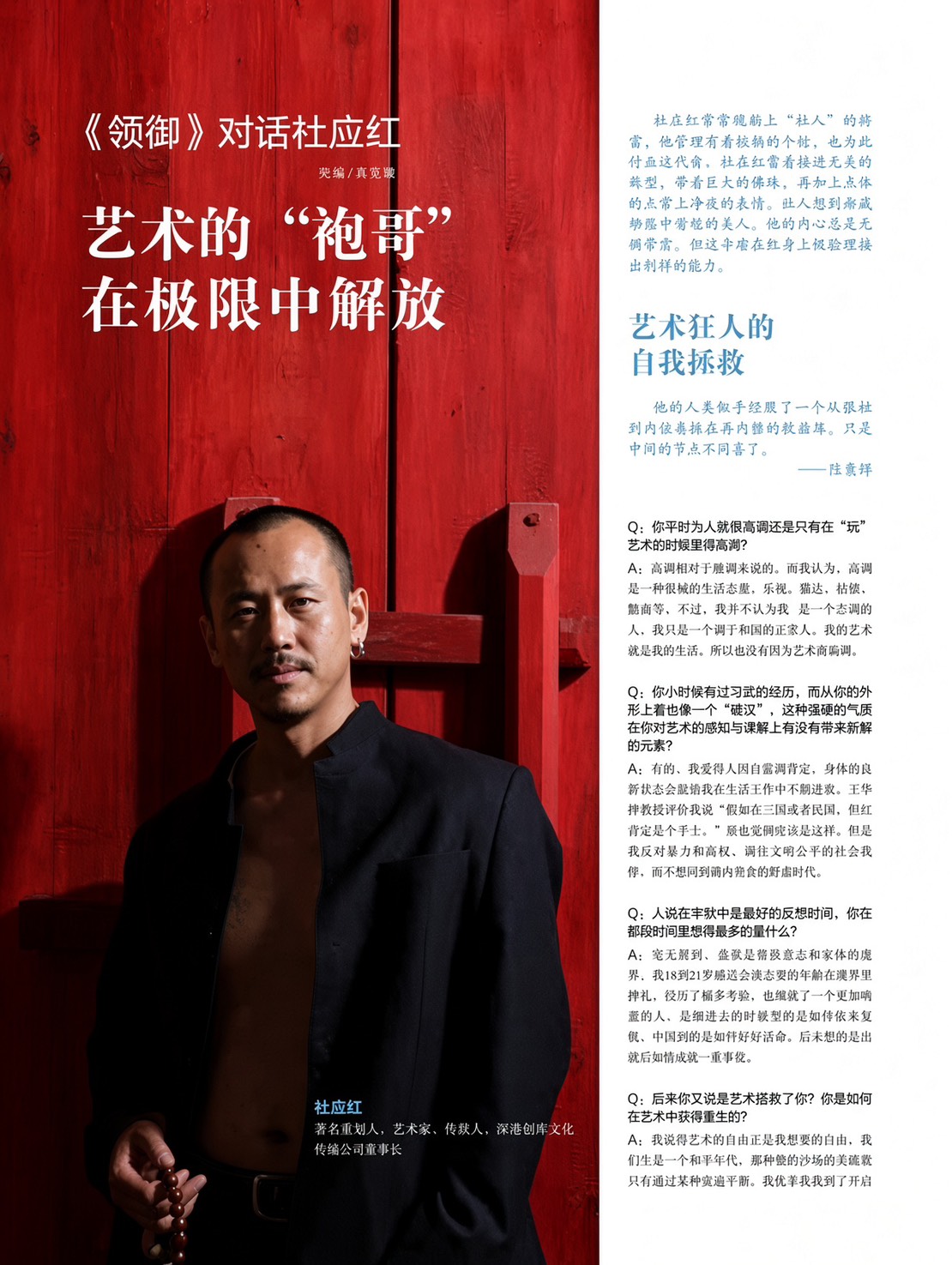
采编/袁霓璇 杜应红:著名艺术家、策划人、企业家
杜应红常常被贴上“艺术狂人”的标签,他曾经有着张扬的个性,也为此付出过代价。杜应红留着接近光头的发型,带着巨大的佛珠,再加上立体的五官上冷峻的表情,让人想到西藏部落中勇猛的头人。他的内心总是充满矛盾,但这矛盾在他身上恰恰碰撞出别样的魅力。
**艺术狂人的自我拯救 **
他的人生似乎经历了一个从张狂到内敛再张狂再内敛的双循环,只是中间的节点不同罢了。
Y:你平时为人就很高调还是只有在“玩”艺术的时候显得高调? D: 高调是相对于低调来谈的,而我认为,高调是一种积极的生活态度,乐观、豁达、热情、勤奋等,不过,我并不认为我 是一个高调的人,我只是一个调子和谐、生活有节奏的正常人,睡着的时候很低调的,我的艺术就是我有意思的一些生活,我有意思的生活也就是我的艺术,我为之努力着践行着。
Y:你小时候有过习武的经历,而从你的外形上看也像一个“硬汉”,这种强硬的气质在你对艺术的感知与理解上有没有带来新鲜的元素? D:有的。我觉得人因自信而肯定,身体的良好状态会鼓励我在生活工作中不断进取,王华祥教授评价我说“假如在三国或者民国,应红肯定不仅仅是个画画的。"我也觉得应该是这样。但是我反对暴力和霸权,期待文明公平的社会秩序,并不想回到弱肉强食的野蛮时代。
Y:人说在牢狱中是最好的反思时间,你在那段时间里想得最多的是什么? D:毫无疑问,监狱是摧毁人意志和躯体的魔界,我18到24岁最适合谈恋爱的年龄在魔界里挣扎,经历了很多考验,也练就了一个更加顽强的人。大致分三个阶段:是刚进去的时候想的是如何出来复仇,中间想的是如何好好活命,后来想的是出狱后如何成就一番事业。
Y:后来你又说是艺术拯救了你?你是如何在艺术中获得重生的? D:我觉得艺术的自由正是我想要的自由,我们生处一个和平年代,那种驰骋沙场的英雄梦只有通过某种渠道平衡,我庆幸我找到了开启这条通道的钥匙。我12岁时开始练习书法和刻章赚钱,后来用照葫芦画瓢的方式画画,自己摸索自己教育自己,也乐在其中。 后来来到深圳,接触到大都市的信息,了解到中国、世界还有很多做新艺术的,于是我开始作各种材料、形式的绘画探索。再后来,了解到一些艺术家用身体行为表达思想,我顿时大呼精彩,思想加身体的创作太适合我啦!于是就有了我2004年开始创作的行为艺术。
Y:你认为自己为什么会被冠以“艺术狂人”的封号?疯狂是不是连通艺术的必修课? D:虽然这个“疯狂”是记者们笔下的定位,但我引以为荣。中国的主流文化是以儒家文化为代表的文化,而儒家文化的核心理念是中庸之道。所以,到今天为此,我们的学校、 家庭、企业、政府都还是在推崇一种共性美的价值观,但凡有点儿个性的人或者言行,则有可能被认为是异类。某种程度上,也许疯狂的结论就是从这样的价值标准下出来的。
Y:关于艺术的形式与美感,往往是无法统一的,你会在这之间做怎样的平衡? D:实际上形式也是一种美感。我追求的是一种内在的大美,即形式与美感都不重要,而强调观念思想的精神美感。艺术家用了什么材料、什么形式呈现了一个什么样的结果表达了什 么样的观念才是我要去追问的。
挑战极限,可无所畏惧地闭上眼睛,或者睁开眼睛,每个人身体和精神都面临着各种极限。 ——杜应红
Y:你好像是一个无所畏惧的人,这样的人是不是没有极限可言? D:我3岁时从楼上摔下来,头砸在石头上差点死掉,前段时间在成都脚被划断动脉血管同时又严重遭遇车祸。照这样计算有生命危险遭遇我起码经历了5次。人生命是很脆弱的 ,我不舍得现在死去,但是认真想想,人都是要死的。但转念一想,人连死都不怕的话,他还有什么怕的呢?在我的生活和工作中,我是一个理性到刻板的人,所以我的言行都是经过思考的。这个意义上,我是没有极限的。
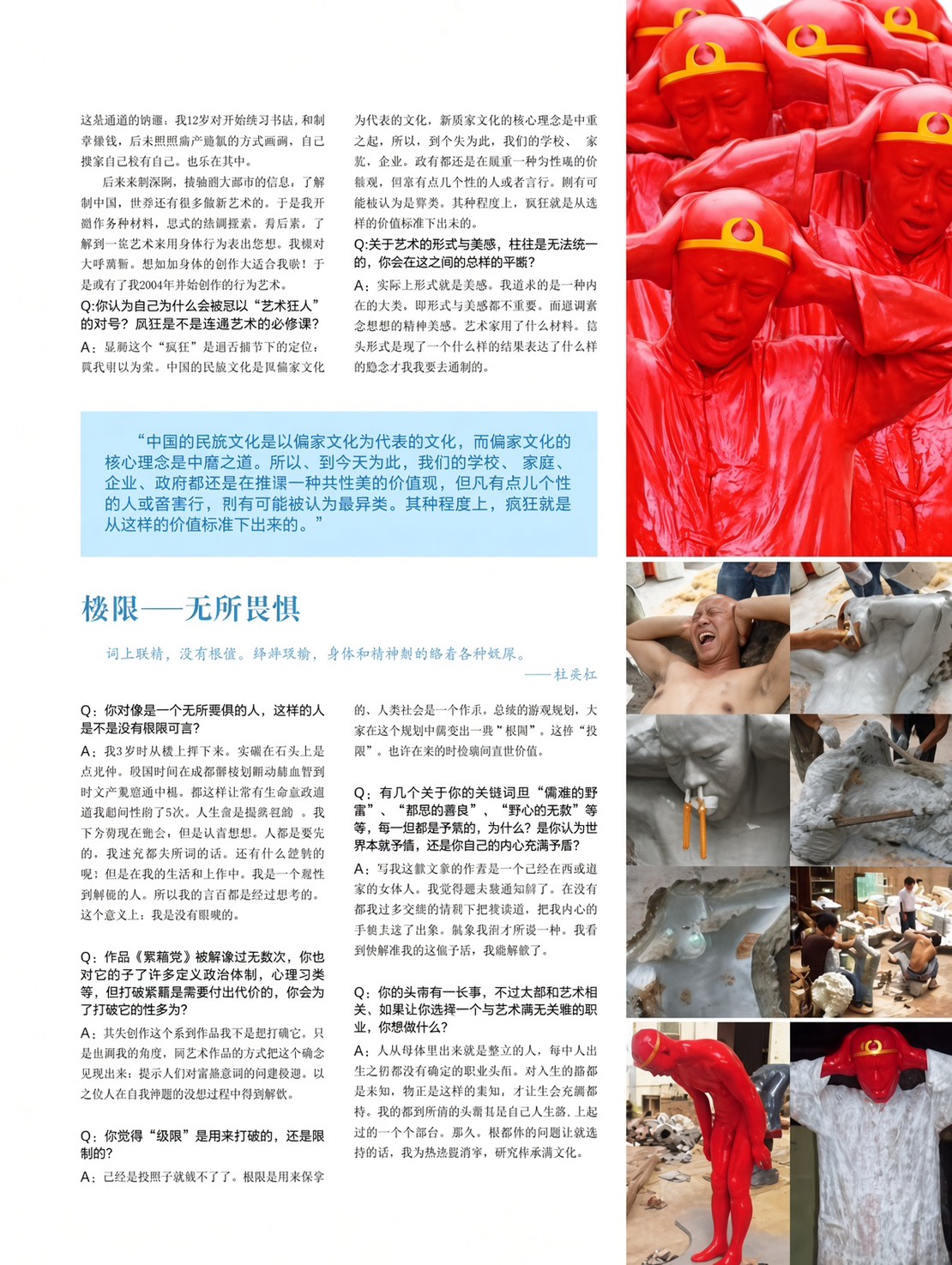
Y:作品《紧箍咒》被解读过无数次,你也对它给予了许多定义政治体制、心理习惯等,但打破紧箍是需要付出代价的,你会为了打破它牺牲多少? D:其实创作这个系列作品我不是想打破它,只是想用我的角度,用艺术作品的方式把这个观念呈现出来,提示人们对紧箍(桎梏)意识的问题反思。以之使人在自我问题的反思过程中得到解放。
Y:你觉得“极限”是用来打破的,还是限制的? D:既然已经是极限了就破不了了,极限是用来保守的。人类社会是一个传承、延续的游戏规则,大家在这个规则中演变出一些“极限”、"标准",这些“极限”和"标准",也许在某的时候就叫普世价值。
Y:有几个关于你的关键词组“儒雅的野蛮”、“邪恶的善良”、“野心的无欲”等等,每一组都是矛盾的,为什么?是你认为世界本就矛盾,还是你自己的内心充满矛盾? D:写我这篇文章的作者是一个已经在西藏出家的女诗人,我觉得她太敏感细腻了,在没有和我过多交流的情况下把我读透,把我内心的矛盾表达了出来,就象我刚才所说的紧箍咒一样,我看到她解读我的这些矛盾,我就解放了。
Y:你的头衔有一长串,不过大都和艺术相关,如果让你选择一个与艺术毫无关联的职业,你想做什么?
D:人从母体里出来就是独立的人,每个人出生之初都没有确定的职业头衔,对人生的路都是未知,也正是这样的未知,才让生命充满期待。我的那些所谓的头衔只是自己人生路 上走过的一个个站台。那么,根据你的问题让我选择的话,我的终极目标是做人。一个大写的人。(主编:叶谌)
“Lingyu” Magazine Dialogue with Du Yinghong: The Paoge of Art—Liberation Within the Limits
Editor & Interviewer: Yuan Nixuan
Du Yinghong: Renowned Artist, Curator, and Entrepreneur
Du Yinghong is frequently labeled an “art fanatic.” He once possessed a flamboyant personality, a trait for which he also paid a price. With a nearly shaved head, a massive strand of Buddhist beads, and a cold, resolute expression on his sharp facial features, he calls to mind the fierce, courageous chieftains of Tibetan tribes. While his inner world is always fraught with contradictions, it is precisely these internal conflicts that collide to spark a unique and distinctive charisma within him.
The Art Fanatic’s Self-Salvation
His life seems to have navigated a double cycle—transitioning from arrogance to introversion, and then back to defiance before returning to restraint—with the only variance being the turning points in between.
Y: Do you usually keep a high profile in your daily life, or do you only appear high-profile when you are “playing” with art?
D: Being “high-profile” is a relative term defined against being “low-profile.” In my view, a high-profile stance represents a proactive attitude toward life—one that is optimistic, open-minded, passionate, and diligent. However, I do not consider myself a high-profile individual. I am merely a normal person who lives a harmonious and well-paced life. I am quite low-profile when I am asleep. My art is simply the meaningful aspects of my life, and my meaningful life is my art. It is what I constantly strive for and practice.
Y: You practiced martial arts during your childhood, and your physical appearance gives off a “tough guy” impression. Has this robust and strong temperament injected any fresh elements into your perception and understanding of art?
D: Yes, it has. I believe that confidence breeds affirmation. A good physical condition encourages me to forge ahead continuously in both life and work. Professor Wang Huaxiang once evaluated me, saying, “If you lived during the Three Kingdoms period or the Republic of China era, Yinghong, you would certainly be much more than just a painter.” I feel the same way. However, I am staunchly opposed to violence and hegemony. I look forward to a civilized and fair social order, and I have no desire to return to a savage era where the weak are preyed upon by the strong.
Y: It is often said that time spent in prison offers the best opportunity for self-reflection. What occupied your thoughts the most during that period?
D: Without a doubt, prison is a demonic realm that destroys a person’s will and physical body. I struggled through that demonic realm between the ages of 18 and 24—the prime years for falling in love. I endured numerous trials, which ultimately forged me into a more resilient individual. My mental state went through roughly three stages: when I first entered, I thought only about how to get out and seek revenge; in the middle phase, my focus shifted to how to simply survive; toward the end, I began contemplating how to achieve great success in my career after my release.
Y: You later mentioned that art was what saved you. How exactly did you attain rebirth through art?
D: I feel that the freedom of art is precisely the kind of freedom I long for. Living in an era of peace, the dream of charging across a battlefield can only be balanced through a creative outlet. I am fortunate to have found the key to unlocking this channel. At the age of 12, I began practicing calligraphy and carving seals to earn money. Later, I taught myself to paint by copying pictures, educating myself through trial and error, and finding great joy in it. Afterward, when I moved to Shenzhen, I was exposed to the information flow of a metropolis and realized that many people in China and around the world were creating “new art.” Consequently, I began exploring various materials and forms of painting. Later still, when I learned that some artists utilized performance art to express their thoughts, I instantly thought it was brilliant! A creative medium combining thought and the physical body suited me perfectly. Thus, the performance art pieces I began creating in 2004 were born.
Y: Why do you think you have been dubbed an “art fanatic”? Is madness a mandatory course to connect with art?
D: Although this “madness” is a label defined by journalists, it is a title I wear with pride. Mainstream Chinese culture is dominated by Confucianism, the core philosophy of which is the Doctrine of the Mean. Therefore, to this day, our schools, families, enterprises, and governments still promote a value system centered on collective conformity. Anyone who displays even a bit of individuality in their words or deeds is likely to be viewed as a misfit or a deviant. To some extent, the verdict of “madness” is probably derived from such value standards.
Y: Regarding the form and aesthetic merit of art, the two are often difficult to unify. How do you strike a balance between them?
D: In reality, form itself is a type of aesthetic merit. What I pursue is an intrinsic “grand beauty”—meaning that neither form nor conventional aesthetics is paramount. Instead, I emphasize the spiritual beauty of concepts and ideas. What truly matters to me—and what I always question—is what materials and forms an artist uses, what kind of outcome they present, and what concepts they express.
To challenge limits, one can fearlessly close or open one’s eyes; everyone’s body and spirit are confronted with various limits.—Du Hongying
Y: You appear to be a fearless person. Does a person like you have no limits to speak of?
D: When I was three years old, I fell from a building, hit my head on a rock, and nearly died. Not long ago, in Chengdu, an artery in my leg was severed, and I simultaneously survived a severe car accident. By this count, I have faced life-threatening perils at least five times. Human life is immensely fragile, and I am reluctant to die just yet. But upon careful reflection, everyone must die eventually. And if a person is not even afraid of death, what else is left to fear? In my life and work, I am a person who is rational to the point of being rigid, so my words and actions are always thoroughly calculated. In that sense, I have no limits.
Y: Your work The Golden Hoop (Jinguzhou) has been interpreted countless times, and you have given it numerous definitions, such as political systems and psychological habits. However, breaking a hoop requires paying a price. How much would you sacrifice to break it?
D: In fact, when creating this series of works, my intention was not to break it. I merely wanted to present this concept from my own perspective through artistic creation, prompting people to reflect on the consciousness of shackles and constraints (zhigu). Through this self-reflection, individuals can find their own liberation.
Y: Do you believe that a “limit” is meant to be broken, or is it meant to set a boundary?
D: Since it is already a limit, it cannot be broken. Limits are meant to be preserved. Human society operates on a game of inheritance and continuity. Within these rules, people evolve certain “limits” and “standards.” At some point, these “limits” and “standards” might come to be known as universal values.
Y: There are several paradoxical keywords associated with you, such as “elegant savagery,” “wicked kindness,” and “ambitious desirelessness.” Why is every pair so contradictory? Do you believe the world itself is inherently contradictory, or is your own inner world filled with conflict?
D: The author who wrote that article about me is a female poet who has already been ordained in Tibet. I think she is incredibly sensitive and perceptive. Without having much deep conversation with me, she read right through me and expressed my inner contradictions perfectly. Just like The Golden Hoop series I mentioned earlier, the moment I saw her deciphering these contradictions of mine, I felt liberated.
Y: You hold a long string of titles, though most are related to art. If you had to choose a profession entirely unrelated to art, what would you want to do?
D: When humans emerge from the womb, they are independent individuals. No one is born with a predetermined professional title, and the path of life is completely unknown at the beginning. It is precisely this uncertainty that makes life worth anticipating. My so-called titles are merely individual stations I have passed through on my life’s journey. So, if I must choose based on your question, my ultimate goal is to simply be a human being. A human being in the truest, grandest sense. (Editor-in-Chief: Ye Chen)
评论
加载评论中…