血红叙事与历史符码的缝合:论杜应红AI艺术中的政治隐喻与传统话语
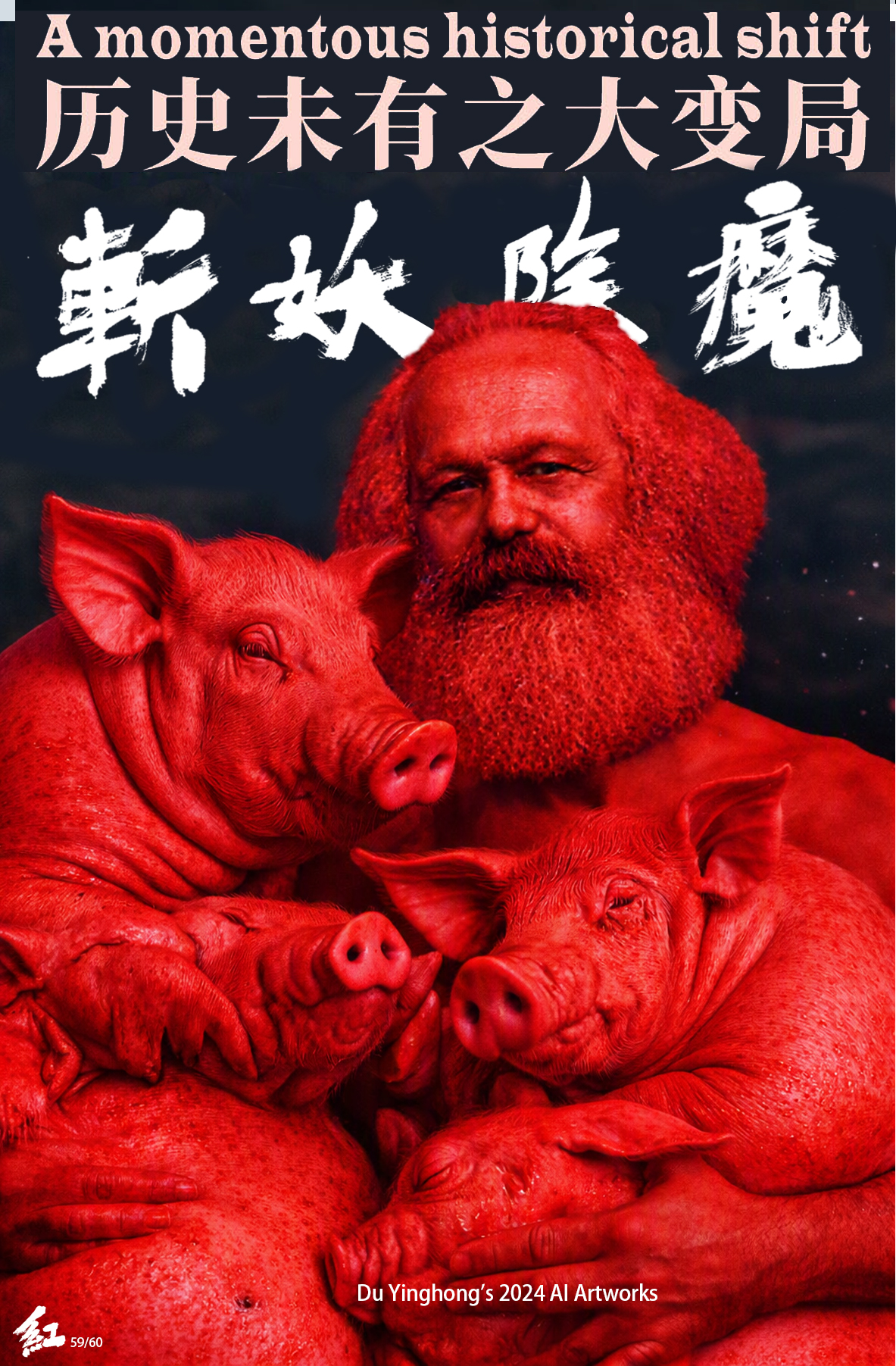
在当代先锋艺术的语境中,人工智能(AI)不仅作为一种高效的生产工具存在,更成为解构宏大叙事与重组文化符码的媒介。艺术家杜应红的最新AI艺术作品,通过高饱和度的“血红”视觉、特定历史人物、动物意象以及传统中国书法文本的并置,构建了一个充满张力与戏谑的政治学与历史学寓言。其中,书法元素“斩妖除魔”的嵌入,不仅完成了本土经验与外来理论的文本缝合,更在深层逻辑上对20世纪以来的历史实践进行了辛辣的清算。
视觉修辞:单色统治下的异化寓言
这幅作品在视觉层面上最显著的特征,是绝对的、黏稠的血红色对画面的统治。卡尔·马克思与数头肥猪的皮肤、毛发被完全同质化为一种非自然的赤红。从艺术学角度看,这种处理消解了生命的本源质感,将理论奠基人与象征物欲、圈养的动物异化为同一种“意识形态标本”。
这种高纯度的红色在当代艺术语境中具有强烈的“政治波普”(Political Pop)色彩。然而,得益于AI对皮肉纹理、光影细节的极高拟真度,这种荒诞的并置产生了一种近乎“实拍”的伪纪实性。这种媒介特性加深了观者的离间感:原本存在于理论和历史文本中的抽象概念,被以一种极具肉体感的形态粗暴地推至眼前,完成了对“红色叙事”的具象化解构。
符号缝合:“斩妖除魔”与意识形态的巫术化
画面上方苍劲有力的中国书法“斩妖除魔”,是理解这件作品本土化批判视角的钥匙。这一元素的加入,其意义至少体现在三个相互交织的维度:
1、历史观的错位与互文 卡尔·马克思的理论是近现代西方理性主义、唯物主义与历史辩证法的产物,旨在“祛魅”世界。而“斩妖除魔”则源自中国传统的民间信仰、宗教及古典神魔话语(如《西游记》式的反叛叙事),属于前现代的宗教与巫术语境。这种前现代的中国民间话语与现代西方政治哲学的并置,精准地隐喻了外来意识形态在特定土壤落地、本土化过程中的“奇异缝合”——当理性的理论被崇拜化、教条化后,它在实践中往往退化为一种排他性的、带有宗教狂热的巫术式动员。
2、话语权的戏谑与反讽 在传统的政治语境中,红色叙事往往自诩为“斩妖除魔”的正义化身,旨在消灭旧世界的“剥削阶级”与“牛鬼蛇神”。然而,在这幅画面中,被全盘“赤化”的马克思与其怀抱中象征特权垄断或盲目群体的肥猪,反而成为了被这四个大字所凝视、所审判的对象。这种主客体的对调,构成了一种极具张力的历史讽刺:曾经的“除魔者”,在权力的异化与历史的异化中,是否最终成为了新的“魔”?
3、民间经验对宏大叙事的消解 书法线条的飞白与宣泄感,代表着一种强烈的非官方、民间的生命力。艺术家借用这种带有草根色彩的传统符号,去对撞画面顶部的宏大官方口号“历史未有之大变局”(A momentous historical shift),实际上是以中国本土的底层经验和传统智慧,去消解、祛魅那些不可一世的、宏大的现代政治神话。
社会学与历史学维度的多重变奏
在社会学层面,画面很难不让人产生关于乔治·奥威尔《动物农场》的联想。画面中肥猪层层叠叠、面目模糊的肉体,暗示了在极端集体主义的框架下,个体的独特性与独立人格被完全吞噬,最终演化为仅具生物本能的权力附庸或被圈养者。马克思对它们的“拥抱”或“抚育”姿态,将社会学中的特权阶层异化与大众盲从关系表现得淋漓尽致。
从历史学维度审视,配合“历史未有之大变局”的文本,作品构成了一次历史宿命论式的回望。从1848年《共产党宣言》的诞生,到20世纪波澜壮阔的乌托邦试验,人类付出了沉重的现实代价。作品将理论的源头与其实践可能导向的物质化、异化结果(肥猪、血红)强行锁死在同一个视觉切片中,是对这段历史路径演进的一次深刻清算。
杜应红的这件作品,展现了跨界艺术家在AI时代的敏锐度。他并未停留在技术层面的视觉猎奇,而是将AI的写实能力、政治符号的解构、以及中国传统的书法话语进行有机融合。通过“斩妖除魔”这一传统符码的嵌入,作品成功地将一场关于现代政治的反思,锚定在了中国本土的历史与文化土壤之中。它不仅是一次视觉上的激进实验,更是一篇关于权力、意识形态与历史怪圈的深刻学术文本。
The Suturing of Red Narrative and Historical Codes: On Political Metaphor and Traditional Discourse in Du Yinghong’s AI Art
In the context of contemporary avant-garde art, Artificial Intelligence (AI) serves not only as an efficient production tool but also as a distinct medium for deconstructing grand narratives and reorganizing cultural codes. The latest AI artwork by artist Du Yinghong constructs a powerful, satirical political and historical allegory through the juxtaposition of highly saturated “blood-red” visuals, iconic historical figures, animal imagery, and traditional Chinese calligraphy text. Within this framework, the embedded calligraphic element “Zhan Yao Chu Mo” (Exorcising Demons) accomplishes a textual suturing of localized experience and imported theory, executing a sharp, deep-level reckoning with 20th-century historical practices.
I. Visual Rhetoric: The Alienated Allegory Under Monochromatic Dominance
The most striking visual feature of this artwork is** the absolute, viscous dominance of blood-red across the entire canvas**. The skin and hair of both Karl Marx and the plump pigs are completely homogenized into an unnatural, stark crimson. From an artistic perspective, this treatment strips away the natural texture of life, alienating both the foundational theorist and his symbolic objects into identical “ideological specimens.”
This highly pure red carries a potent “Political Pop” undertone within the lexicon of contemporary art. However, leveraged by AI’s exceptional fidelity in rendering flesh textures and lighting details, this absurd juxtaposition takes on a near-“photorealistic” quality. This medium-specific attribute deepens the viewer’s sense of estrangement: abstract concepts that previously existed only in theoretical and historical texts are crudely thrust before the eyes in a visceral, corporeal form, achieving a vivid visual deconstruction of the “red narrative.”
II. Symbolic Suturing: “Zhan Yao Chu Mo” and the Witchcraftization of Ideology
The vigorous Chinese calligraphy characters “Zhan Yao Chu Mo” (斩妖除魔 / Exorcising Demons) positioned at the top of the frame serve as the key to unlocking the localized critical perspective of this work. The inclusion of this element carries profound significance, functioning across three intertwined dimensions:
1、The Dislocation and Intertextuality of Historical Frameworks Karl Marx’s theories are the product of modern Western rationalism, materialism, and historical dialectics, designed to “disenchant” the world. Conversely, “Zhan Yao Chu Mo” originates from traditional Chinese folk beliefs, religion, and classical mythological discourse—such as the rebellious narratives found in Journey to the West—belonging firmly to a pre-modern, spiritual context. Juxtaposing pre-modern Chinese folk discourse with modern Western political philosophy precisely metaphors the “bizarre suturing” that occurs when an imported ideology lands and takes root in specific domestic soil. When rational theory is deified and dogmatized, its practical application frequently degenerates into an exclusionary, zealotry-driven form of political sorcery.
2、The Satirical Inversion of Discourse In orthodox political rhetoric, the red narrative has historically framed itself as the righteous embodiment of “exorcising demons,” aimed at eradicating the “exploiting classes” and “monsters and demons” of the old world. In this visual arrangement, however, the thoroughly “reddened” Marx and the pigs in his embrace—signifying either privileged monopolies or blindly compliant masses—become the very subjects stared down and judged by those four bold characters. This inversion of subject and object creates a brilliant historical irony: did the original “exorcist,” through the alienation of power and history, ultimately transform into the new “demon”?
3、The Dissolution of Grand Narratives by Localized Experience The expressive, free-flowing brushstrokes of the calligraphy embody a raw, non-official vitality of popular origin. By utilizing this grassroots traditional symbol to confront the grand official slogan at the top, “A momentous historical shift” (历史未有之大变局), the artist effectively employs indigenous Chinese bottom-up experience and traditional wisdom to dissolve and disenchant an otherwise formidable, modern political myth.
III. Multilayered Variations in Sociological and Historical Dimensions
Sociologically, the imagery of the crowded, faceless flesh of the pigs inevitably invokes George Orwell’s Animal Farm. It hints at how, within the framework of extreme collectivism, individual uniqueness and independent personality are entirely swallowed up, ultimately reducing people to a featureless mass of political dependents or caged entities driven purely by biological instinct. Marx’s pose of “embracing” or “nurturing” them vividly captures the sociological dynamic between a mutated elite class and an uncritical, compliant public.
Examined from a historical dimension, paired with the text “A momentous historical shift”, the artwork stage-manages a fatalistic retrospective look at history. From the birth of The Communist Manifesto in 1848 to the tumultuous utopian experiments of the 20th century, humanity has paid a heavy price in reality. By binding the source of the theory and its ultimate, alienated material outcomes (the pigs, the blood-red) into the exact same visual slice, the piece delivers a profound reckoning with the evolution of this historical path.
Du Yinghong’s work showcases the acute sensitivity of a multidisciplinary artist in the era of AI. Rather than stopping at technical visual novelty, he integrates the realist precision of AI, the deconstruction of political icons, and traditional Chinese calligraphic discourse. By embedding the traditional code of “Zhan Yao Chu Mo”, the artwork anchors an overarching reflection on modern politics deep within the soil of Chinese history and culture. It is not only an aggressive visual experiment but a profound academic text exploring power, ideology, and the cyclical traps of history.
评论
加载评论中…