The Bestiality of Power and the Neo-Totalitarian Hell: Diabolical Rhetoric and Political Deconstruction in Du Yinghong’s "Kung Fu Calligraphy"
Introduction: A Visual Manifesto Piercing the Night of Modern Tyranny
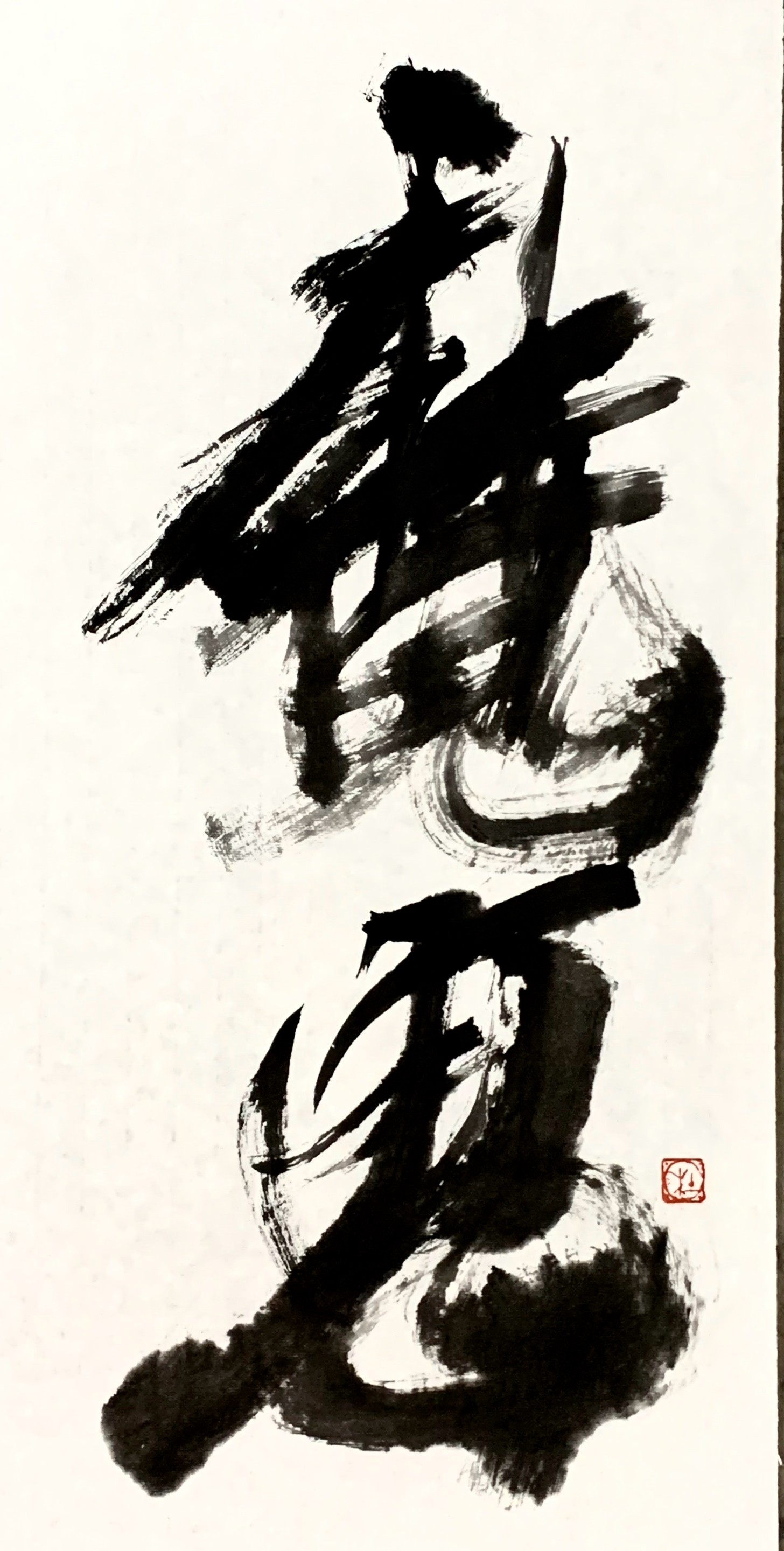
This racing, turbulent trace of ink is a visual manifesto slicing through the dark night of twenty-first-century neo-totalitarianism. The two vertically aligned Chinese characters, “魔鬼” (Móguǐ / “The Devil” or “Demon”), leap off the paper with a hair-raising visual tension that shatters the serenity of the Xuan paper. The upper character, “魔” (Devil), is a dense, violent entanglement of parched ink (Jiaomei), dry brushwork, and dramatic streaks of white space (Feibai), visually evoking the intricate surveillance grids and oppressive machinery of contemporary totalitarian governance. The lower character, “鬼” (Demon/Ghost), is rooted in deep, heavy, and abruptly punctuated pools of splashed ink (Pomei), resembling a ravenous beast lurking in the shadows of history, poised to devour fundamental human rights.
In this work, contemporary artist Du Yinghong thoroughly fuses the foundational techniques of traditional Chinese calligraphy—which he has mastered since the age of seven—with the somatic principles of Chinese martial arts, including “storing energy, explosive release, shifting tempos, and ferocious strength.” Crucially, he strips calligraphy of its historical, decorative function within the scholar-bureaucratic class, transforming it into a modern** visual weapon deployed for global political critique, the defense of human rights, and the pursuit of freedom.** “The Devil” in this context is a concrete, damning indictment of the neo-totalitarian terrorism enveloping the modern world.
I. Political Anatomy of “Diabolical Rhetoric”: Naming the Axis of Communist Tyranny and Modern Despotism
In the discourse of political philosophy, “The Devil” serves as a synonym for absolute evil and the institutional leviathan of total state control. Du Yinghong’s act of inscribing “The Devil” via “Kung Fu Calligraphy” is a precise and explosive exercise in political rhetoric:
Concretizing the Neo-Totalitarian Axis: The focal point of this masterpiece is directed squarely at the absolute autocrats of the twenty-first century—dictators who represent the toxic remnants of Communist despotism and modern terrorism, explicitly personified by figures such as Vladimir Putin, Xi Jinping, and Kim Jong-un. Under the pretext of state machinery, these figures trample upon human rights, suffocate liberty, and manufacture regional and global terror. Through raw, furious brushstrokes, Du symbolisms these dictators as “The Devil,” stripping away their manufactured “legitimacy” and grand state narratives.
Visualizing Institutional Absurdity and Pathology: The contemporary evolution of Communist totalitarianism manifests as a hyper-obsessive demand for societal control mixed with profound absurdity. Through the violent friction between the parched dry brush and the saturated splashed ink in the characters “魔鬼,” Du visually translates the system’s distortion of human nature, its trampling of civilization, and the pathological, sinister phenomena pervasive in modern totalitarian societies.
II. Somatic Politics and Martial Defiance: Weaponizing Individual Kinetic Energy Against State Terror
Du Yinghong’s pioneering methodology of “Kung Fu Calligraphy” achieves an unparalleled “aesthetic of confrontation” when confronting the motif of “The Devil”:
The Brushstroke as a Battlefield: Calligraphy sanctioned by traditional state apparatuses typically values “moderation, harmony, and state hagiography,” serving as an ornamental accomplice to power. Du, conversely, injects the combativeness and rhythm of martial arts into the trajectory of the brush. Every sweep and abrupt halt carries the explosive force of muscle memory. This is a** somatic duel waged by an individual against a monolithic system**; the compression and release of the brush tip become martial forms designed to combat state terrorism.
Anti-Institutional Aesthetic Violence: The lines shaping the characters “魔鬼” reject geometric order, opting instead for a deliberate friction imbued with rage and defiance. This radical aesthetic violence completely subverts the “sublime and flawless” propaganda aesthetics championed by totalitarian regimes. The artist deploys a rebellious, living kinetic energy to counteract the cold, mechanical, and necrotic nature of neo-totalitarianism.
III. Sociological Witnessing: A Decades-Long Praxis of Historic “Linguistic Monument-Building”
The profound international resonance and social influence of Du Yinghong’s artistic praxis stem from his decades-long commitment to documenting public crises and current events. He is not a literati scholar cloistered in an ivory tower, but an active witness of his era wielding a brush
Whenever public authority is weaponized, human rights are violated, or dictators stage the grotesque, pathological farces of autocracy, Du uses calligraphy as a medium to sound a global alarm. In an era where neo-totalitarian regimes systematically deploy internet censorship and information blockades to sanitize collective memory, Du permanently fixes these atrocities, systemic pathologies, and the collective will to resist onto Xuan paper. This act of “linguistic monument-building” carries irreplaceable sociological value—it consolidates the individual will of those who refuse to be subjugated, using the lifeblood of traditional culture to bear witness to the universal values of liberty and democracy.
Conclusion: A Torch of Liberty Illuminating the Darkness of Global Tyranny
Du Yinghong’s “Kung Fu Calligraphy” definitively proves that traditional culture in a modern context is not merely a vehicle for historical nostalgia; it can serve as a vanguard force fighting at the front lines to pierce global authoritarian gloom and safeguard human rights.
By melting the ferocious vigor of martial arts, the historical depth of calligraphy, and an unyielding fury against societal decay into the tip of his brush, Du has delivered a profound artistic verdict. Metaphorically, this piece, “魔鬼,” is not only a furious condemnation of the terrorist tyrannies epitomized by Putin, Xi, and Kim, but also a powerful clarion call to the free will of humanity. Du Yinghong has inscribed a distinctive paradigm into the history of contemporary anti-totalitarian art—wielding an ancient brush to champion universal liberty, converting the paper into a battlefield, and turning written characters into a consuming fire that incinerates the devil.
评论
加载评论中…