The Cold War Chessboard of Geopolitics and the Liquid Archive of Consumerism: A Critical Review of Du Yinghong’s Installation Art Wine Chess, Chess Wine
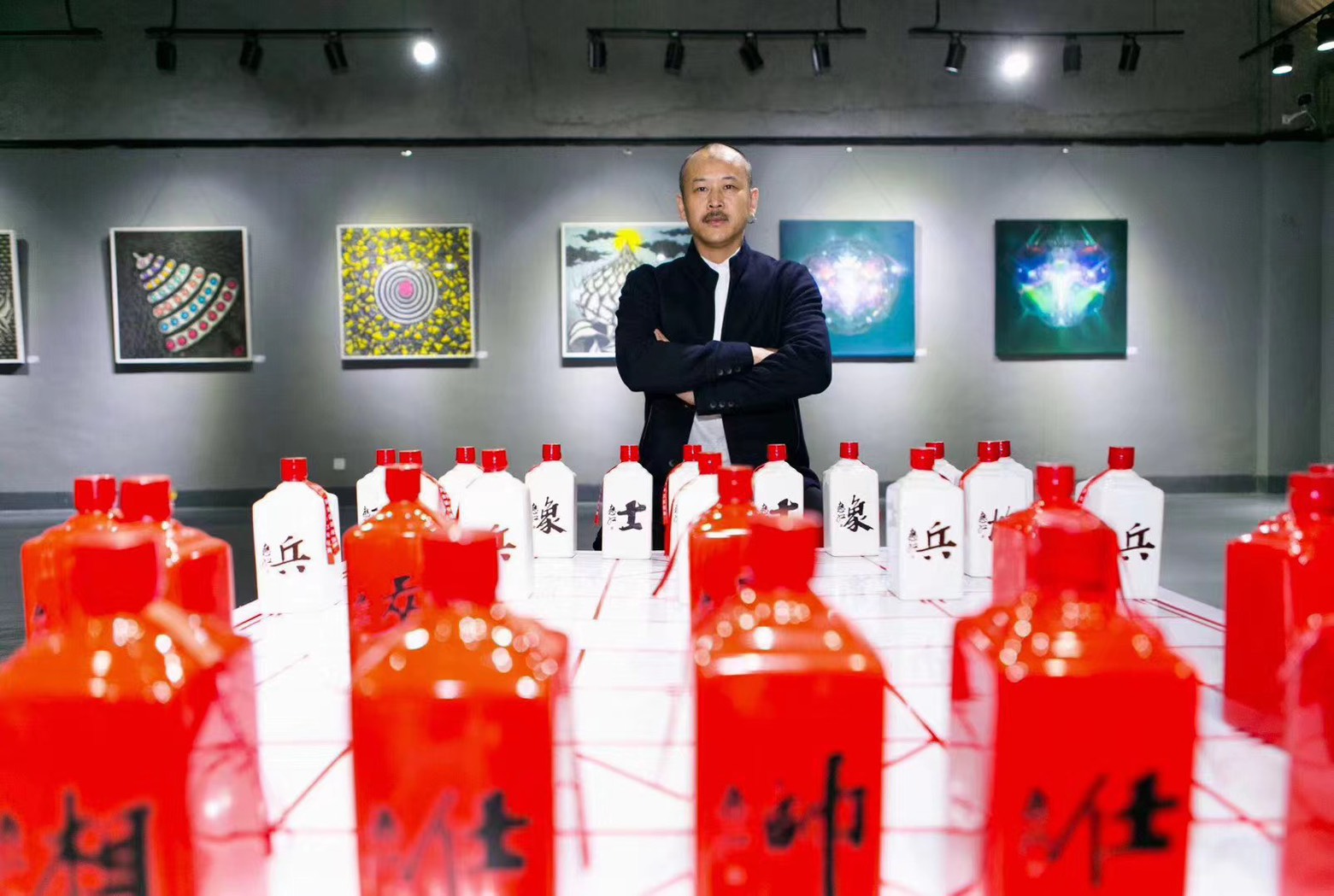
In the coordinates of contemporary cross-disciplinary installation art, artist Du Yinghong’s installation Wine Chess, Chess Wine stands out as an exceptionally ambitious and tension-fueled experiment. This work is not merely a cross-dimensional material synthesis of agricultural, industrial, and intelligent civilizations; it is a social theater that forcefully sutures Eastern traditional “ritualistic order” (Li) with modern “geopolitics.”
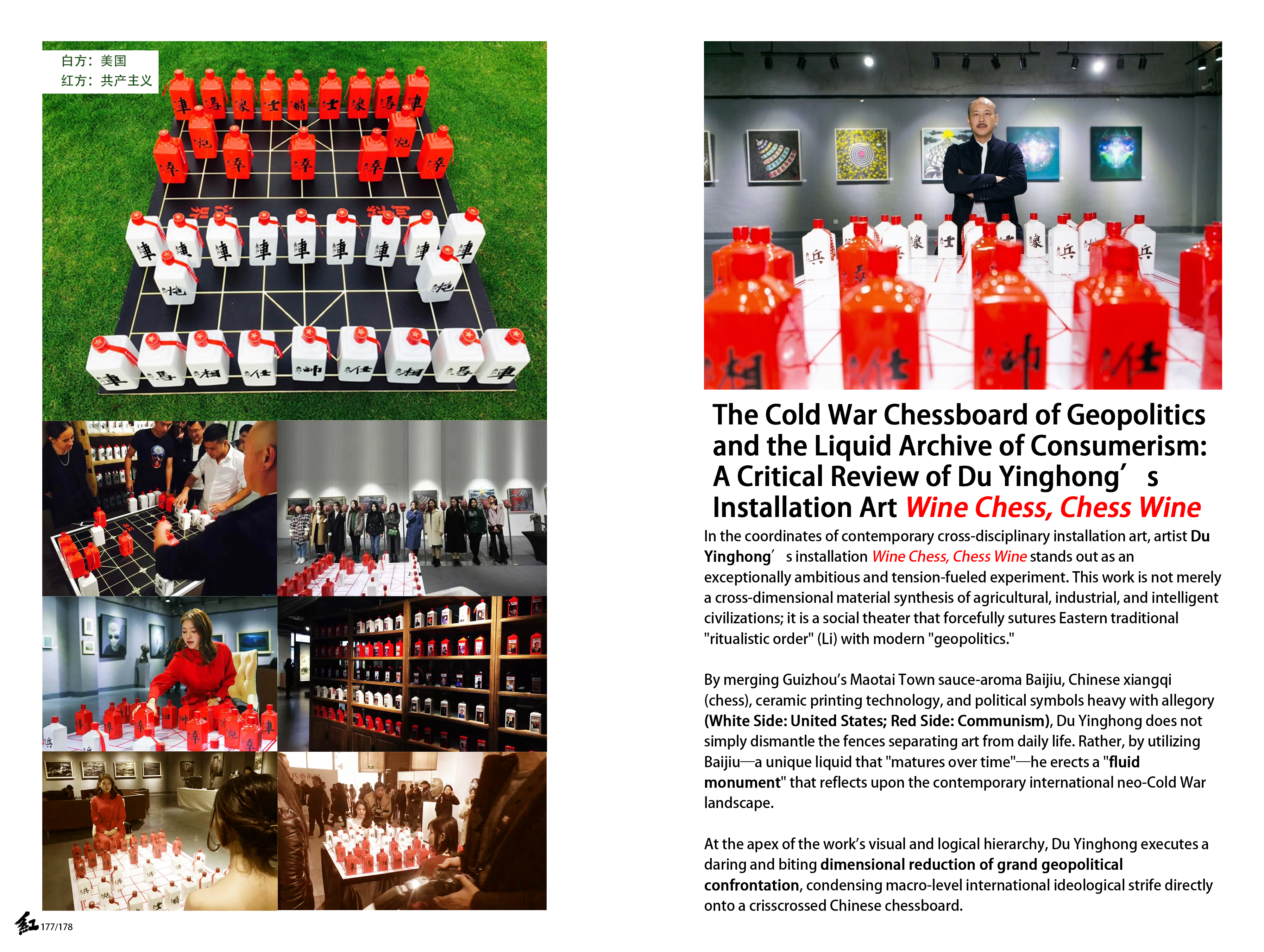 By merging Guizhou’s Maotai Town sauce-aroma Baijiu, Chinese xiangqi (chess), ceramic printing technology, and political symbols heavy with allegory (White Side: United States; Red Side: Communism), Du Yinghong does not simply dismantle the fences separating art from daily life. Rather, by utilizing Baijiu—a unique liquid that “matures over time”—he erects a “fluid monument” that reflects upon the contemporary international neo-Cold War landscape.
At the apex of the work’s visual and logical hierarchy, Du Yinghong executes a daring and biting dimensional reduction of grand geopolitical confrontation, condensing macro-level international ideological strife directly onto a crisscrossed Chinese chessboard.
The Imperial Entity of the White Side (United States): Within the White camp, the frontline is abruptly and aggressively lined with an entire row of “Rooks” (Che). In Chinese chess, the Rook symbolizes absolute strength, possessing the ultimate mobility and lethality. This design precisely translates the “absolute power” and offensive posture of the United States as an established superpower, crashing through global geopolitics via military and economic hegemony.
The Totalitarian Allegory of the Red Side (Communism): Opposing it, the Red camp is swathed in the dense colors of red ideology. This red-versus-white confrontation immediately conjures the bloc dualism of the Cold War era. In the Red camp’s pieces, the traditional gaming power is contextualized within “defending the headquarters” and “crossing the river of class,” forming a bizarrely asymmetric strategic standoff against the White side’s “all-Rook advance.”
Du Yinghong transforms this grand political gambit—which dictates human destiny—into chess pieces that can be arbitrarily manipulated, touched, or even “drunk” by audiences at a daily dinner table or within an exhibition hall. This is not only a dissolution of geopolitical myths but also a banalization of political metaphors heavily tinted with the spirit of Pop Art.
Unlike traditional installation art that utilizes cold stone, wood, or metal, Du Yinghong insists on using “sauce-aroma Baijiu that matures over time” as his core creative material. This choice imbues Wine Chess, Chess Wine with a unique “temporal depth” and “dynamic narrative.”
As the years slide past, the Baijiu silently ferments inside its porcelain bottles, its flavor profile growing richer and more fragrant with age. This physical attribute creates a perfect intertextuality with the evolution of geopolitics: Will the gambit between the United States and Communism eventually achieve a historical “reconciliation and fragrance” like aged wine over time, or will it completely spoil under a protracted standoff?
The liquor becomes the ink that logs time; the chess bottles become the archives that seal history. Every movement of a piece and every tasting by the audience represents a direct corporeal and sensory ingestion and interaction with this “history in fermentation.”
At the textual level, the work attempts to echo the historical anecdote recorded by Sima Qian in the Records of the Grand Historian regarding Emperor Wu of Han praising the ancient wine as “sweet and beautiful,” thereby continuing Du Yinghong’s philosophy of “shaping objects with ritual, embedding ritual within objects.” However, in the actual presentation of the installation, what we witness is a modern alienation and restructuring of this traditional Eastern order.
The essence of Chinese chess lies in the gambit of “ritual” (Li) and “order” (Xu), emphasizing rules, hierarchy, and restraint. Yet, when Du Yinghong crams the two incompatible modern political leviathans—the United States and Communism—into this ancient framework, traditional Confucian virtues of gentleness and restraint are instantly torn asunder by the blood and cruelty of the modern Cold War. Each porcelain bottle, inscribed with “Kung Fu calligraphy,” serves simultaneously as a ritual vessel of civilizational gifting and a lethal weapon of geopolitical slaughter. This violent tension between “ritual” and “weaponry,” between “cultural root-seeking” and “ideological confrontation,” constitutes the deepest critical power of the work.
As evident from the exhibition sites documented in the images, this work completely bypasses the elite myth of the museum “white cube” where touching is strictly forbidden.
Inside the gallery, elegantly dressed cosmopolitan women, young art students, and ordinary members of the public can directly reach out their fingers to engage in the game.
Here, the artwork simultaneously acquires commercial and utilitarian attributes: it is “consumable, displayable, and collectible.”
Du Yinghong brilliantly utilizes the distribution channels of consumerism, disguising the methodology of avant-garde performance art as a high-end “cultural derivative.” When people talk politics over drinks, deduce the Sino-US gambit over a chessboard, and swallow the “chess pieces” symbolizing ideology amid toasts, this cross-disciplinary performance art achieves its most thorough sociological integration within the earthy smoke and fire of daily life.
Wine Chess, Chess Wine is another heavyweight cross-disciplinary work within Du Yinghong’s trajectory of geopolitical critique. It not only showcases the exquisite synergy of traditional Chinese ceramics, calligraphy, and Baijiu craftsmanship, but also operates as a cold, postmodern funhouse mirror, reflecting the Cold War mentality and bloc confrontation resurging globally today. Du Yinghong uses a tactical game of wine-chess to tell the world: at the gluttonous feast of history and politics, whether it is the formidable “Rook of the White Side” or the dug-in “Pawn of the Red Side,” all will ultimately be sealed by the torrent of time within the porcelain bottles of the common people, becoming a cup of aged wine for posterity to coolly appraise.
评论
加载评论中…