Du Yinghong’s "Applying for the Position of Chairman of the Shenzhen Federation of Literary and Art Circles": Deconstruction of the System and Artistic Intervention
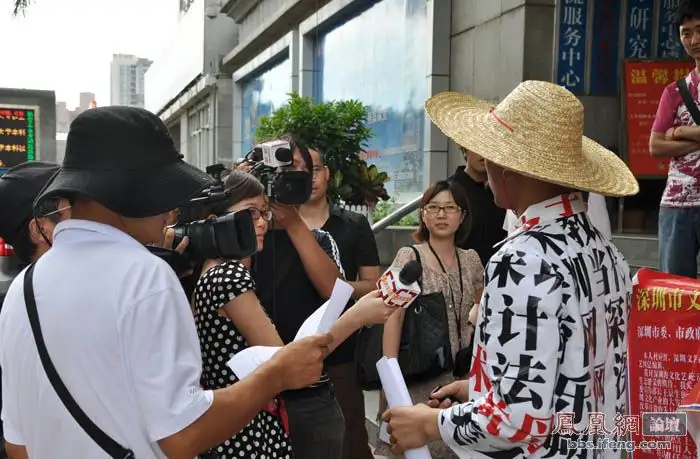
On July 19, 2010, at the entrance of the Shenzhen Talent Market—a landmark site that once bore witness to the capital miracles and population migration of Southern China—a thrilling performance of “narrative usurpation” took place. Dressed in his iconic outfit printed with cultural signifiers, wearing a straw hat, and holding his administrative program high with both hands, artist Du Yinghong publicly announced his application for the position of “Chairman of the Shenzhen Literary and Art Federation” (Wenlian). While this action appeared to be a direct “job application” response to the Shenzhen municipal government’s public listing of a vacant Wenlian position, its essence was a meticulously calculated campaign of Institutional Critique. Using his physical body as a grassroots, independent agent, Du violently dragged a “black-box selection process,” traditionally monopolized by an authoritarian bureaucratic system, out into the sun-drenched public square. This work stands not only as a radical challenge to institutionalized power but also as a classic, deeply satirical text of monumental political and diagnostic value within the history of contemporary Chinese conceptual art in the internet era.
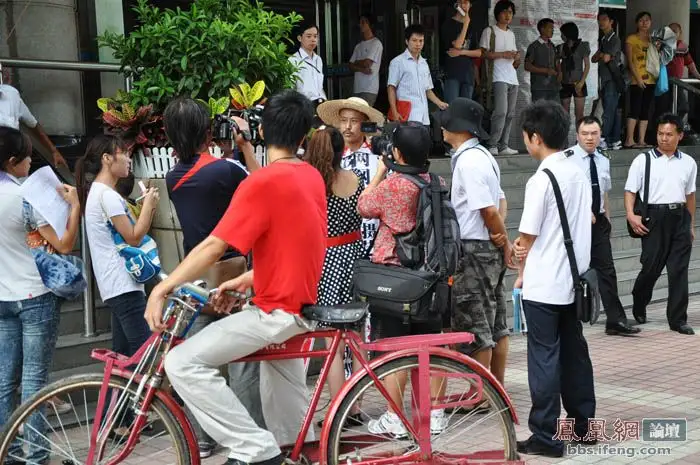 The primary brilliance of Du Yinghong’s work lies in his precise choice of Site-Specific creation. In the narrative of China’s reform and opening up, the Shenzhen Talent Market stood as a symbol of how tens of millions of ordinary laborers secured their survival and achieved class mobility through sheer individual capability. It embodied the most fundamental logic of market competition and contractual spirit.
Yet within this vast arena that championed meritocracy, high-ranking bureaucratic positions within the regime—such as the Chairman of the Wenlian—had always remained a forbidden zone inaccessible to civil society. By establishing his job application platform at this exact location, Du manufactured a highly dramatic sociological dislocation:
The government’s so-called “public notification and solicitation of public opinions” was originally nothing more than a cynical, bureaucratic ritual designed to whitewash nepotism. Du “took the fiction seriously,” showing up with a rigorous administrative program in a posture that aligned perfectly with a modern civil service system, thereby tearing away the regime’s final pretense of democracy.
He transformed a mundane venue for labor exchange into an “ideological examination room” for judging a corrupt bureaucratic apparatus. As he read his administrative program aloud on the square, he executed a democratic reconfiguration of space, forcing every ordinary taxpayer watching to reflect on the true source of power’s legitimacy.
In Du Yinghong’s artistic discourse, the Shenzhen Wenlian and its subordinate associations are sharply diagnosed as “cosmeticians and propagandists of an authoritarian regime.” These bureaucratic organs, heavily subsidized by taxpayers, tend toward creative stagnation and docility, functioning primarily to maintain institutional stability through aesthetic domestication.
In stark contrast, Du, as an independent individual completely devoid of state resource support, funded magazines, established the Shenzhen Literature and Art web portal network, opened art districts, and consistently organized avant-garde exhibitions and salons. This “one-man army” grassroots practice endowed his presence at the application site with an unassailable moral and professional legitimacy:
When Du presented his administrative program and past achievements, he used the physical “presence” of a genuine, highly creative contemporary artist and curator to deliver a crushing blow to the institutional “sycophants and eunuchs” who did nothing but squander taxpayer funds.
Through real-time documentation by media outlets like the Southern Metropolis Daily and the ensuing tidal wave of online discourse, Du utilized the amplification effect of the early internet public sphere to “roast these hidden bureaucrats on an oven rack.” This artistic intervention laid bare the vulnerability, avarice, and stagnation of the institution, triggering a massive societal reflection on whether such cultural ministries should exist at all.
To measure the weight of Du Yinghong’s socially engaged art during this period, one must place it within the political context of high-pressure authoritarian control. In China, the hierarchy and authority of the bureaucratic system are absolute, sacred totems that must never be transgressed. An ordinary citizen publicly announcing an attempt to seize a bureau-level propaganda position through a public talent market was viewed by authorities as an open provocation and mockery of the political order.
The reason this piece achieves a sublime sense of tragedy—resembling a moth flying into a flame—lies in the Aesthetics of Risk borne by the artist. By launching this protest in a highly visible public space, Du faced not only institutional blacklisting but also the immediate threat of imprisonment under arbitrary catch-all charges such as “disrupting social order” or “picking quarrels and provoking trouble.“It was precisely this resolute stance of a physical body crashing head-on into a totalitarian machine that elevated Applying for the Chairmanship of the Shenzhen Literary and Art Federation far beyond ordinary street performance or a flash-mob stunt. At that moment, Du Yinghong’s body transformed into a spiritual thumbtack, firmly pinned into the raw nerve of the bureaucratic regime.
Du Yinghong’s 2010 work Applying for the Chairmanship of the Shenzhen Literary and Art Federation remains an unskippable milestone in the history of contemporary Chinese Socially Engaged Art and Institutional Critique.
Like a Don Quixote charging at windmills with a wooden sword, his blade nevertheless managed to precisely lance the most corrupt ulcer of the bureaucratic elite. This “political mimicry of job seeking” initiated at the gates of the Shenzhen Talent Market completed a dual deconstruction of macro-ideology and authoritarian cultural ministries in the rowdiest yet most serious manner possible. It was a sovereign declaration by an independent intellectual, proving that under the heavy weight of an unyielding system, a true artist can use his own body and intellect to strip away an absurd reality, allowing justice and dignity to soar proudly under the camera flashes of the public square.
评论
加载评论中…