Retrieving History and Locally Reshaping the Memories of a Lone Force: Du Yinghong’s Documentary *The Story of Asia*
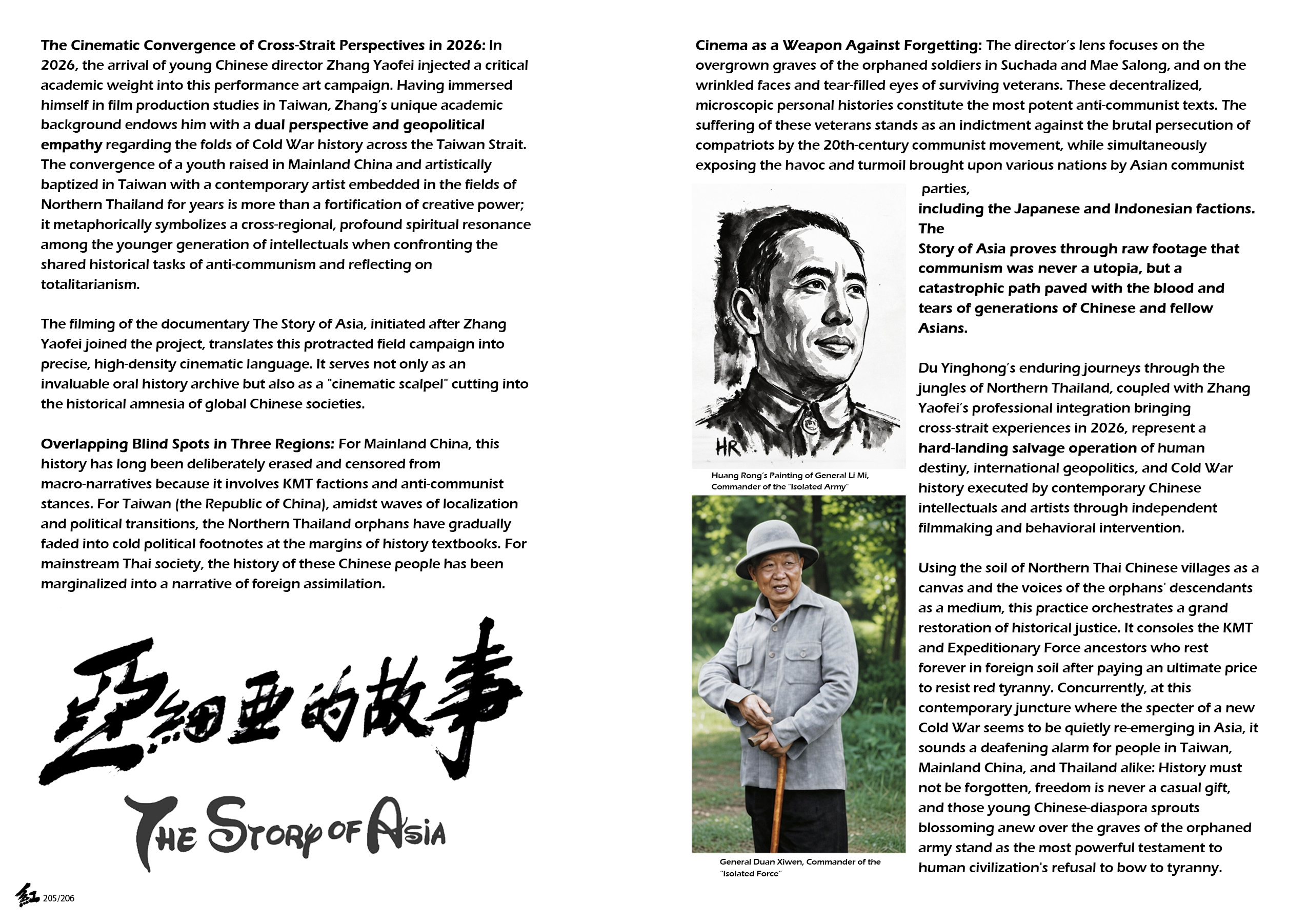
On the fringes of Cold War geopolitics, amidst the rolling dust of the Golden Triangle, lies a profoundly tragic chapter of Chinese memory that has long been exiled from mainstream historical narratives—the exile and blood-soaked history of the orphaned Chinese Nationalist (KMT) army in Northern Thailand (originally the Chinese Expeditionary Force and the 93rd Division of the Republic of China Army). Stranded in the fissures of history, possessing “neither nationality nor a path of retreat,” these Chinese forebears used their physical bodies to withstand the total encroachment of international communism in the jungles of Southeast Asia. From Du Yinghong’s solitary field investigations in the early years to the official arrival in 2026 of Zhang Yaofei—a young Chinese director who studied film production in Taiwan—this multi-year artistic campaign has evolved into a radical manifestation of Socially Engaged Art and cinematic historiographical intervention. Together, by sponsoring Chinese-diaspora schools, teaching the song The Orphan of Asia, and co-directing the documentary The Story of Asia, they have used independent, embodied action to salvage anti-communist historical truths buried beneath layers of ideology, initiating a profound spiritual awakening across contemporary Mainland China, Taiwan, and Thailand.
To comprehend the profound significance of Du Yinghong and Zhang Yaofei’s socially engaged work, one must first reconstruct the brutal international geopolitical landscape behind the KMT army in Northern Thailand.
Following the Chinese Civil War, this unit, composed of remnants of the Chinese Expeditionary Force, retreated into the Thai-Burmese borderlands. During the mid-20th century, a period marked by the aggressive global expansion of international communism, these “orphaned soldiers,” abandoned by their motherland, became the absolute front line against the red tsunami in Southeast Asia.
At the height of the Cold War, the toxins of international communism, backed by the Soviet Union and the Chinese Communist Party, spread across Southeast Asia. Forces such as the Pathet Lao (Laos), the Khmer Rouge (Cambodia), the Communist Party of Burma, the Communist Party of Thailand (CPT), the Malayan Communist Party, the Communist Party of Malaya, the Singapore Communist Party, the Communist Party of Indonesia, and the Japanese Communist Party formed a violent web aimed at turning the entire Indochinese Peninsula red and destabilizing East Asia.
When the CPT stood on the verge of capturing Northern Thailand, the 93rd Division answered the call of the Thai government. They fought fiercely in battles such as Doi Phamon and Doi Pha Dang. Trading the bones of thousands of their compatriots, they not only secured legal residency in Northern Thailand but also severed the strategic chains of international communism in Southeast Asia, safeguarding Thailand’s democracy and freedom.
Du Yinghong’s intervention acts primarily as a historical vindication of this monumental geopolitical legacy. He rescues these orphaned soldiers from the stigmatizing narrative of being “Golden Triangle remnants,” restoring their exalted historical status as pioneers who fought communism to defend the land.
The logic of this project bears a distinct hallmark of micro-resistance by individuals, achieving a structural upgrade over time from a “solitary action” to a “professional cinematic intervention.”
In the project’s nascent phase, Du Yinghong traveled alone across nearly a hundred Chinese villages in Northern Thailand. This unsparing, solitary journey was a saint-like “bodily pilgrimage” through Cold War history. In the rudimentary classrooms of local Chinese schools, he taught the children to sing Lo Ta-yu’s iconic piece, The Orphan of Asia: “A yellow face stained with red mud, black eyes filled with white fear.” In Northern Thailand, these lyrics are the lived reality of these children’s grandfathers and fathers. Through song and material aid, Du built a microscopic barrier against cultural amnesia, countering the long-standing spiritual toxicity inflicted by international communism upon Asian civilization and traditional culture.
In 2026, the arrival of young Chinese director Zhang Yaofei injected a critical academic weight into this performance art campaign. Having immersed himself in film production studies in Taiwan, Zhang’s unique academic background endows him with a dual perspective and geopolitical empathy regarding the folds of Cold War history across the Taiwan Strait. The convergence of a youth raised in Mainland China and artistically baptized in Taiwan with a contemporary artist embedded in the fields of Northern Thailand for years is more than a fortification of creative power; it metaphorically symbolizes a cross-regional, profound spiritual resonance among the younger generation of intellectuals when confronting the shared historical tasks of anti-communism and reflecting on totalitarianism.
The filming of the documentary The Story of Asia, initiated after Zhang Yaofei joined the project, translates this protracted field campaign into precise, high-density cinematic language. It serves not only as an invaluable oral history archive but also as a “cinematic scalpel” cutting into the historical amnesia of global Chinese societies.
For Mainland China, this history has long been deliberately erased and censored from macro-narratives because it involves KMT factions and anti-communist stances. For Taiwan (the Republic of China), amidst waves of localization and political transitions, the Northern Thailand orphans have gradually faded into cold political footnotes at the margins of history textbooks. For mainstream Thai society, the history of these Chinese people has been marginalized into a narrative of foreign assimilation.
The director’s lens focuses on the overgrown graves of the orphaned soldiers in Suchada and Mae Salong, and on the wrinkled faces and tear-filled eyes of surviving veterans. These decentralized, microscopic personal histories constitute the most potent anti-communist texts. The suffering of these veterans stands as an indictment against the brutal persecution of compatriots by the 20th-century communist movement, while simultaneously exposing the havoc and turmoil brought upon various nations by Asian communist parties, including the Japanese and Indonesian factions. The Story of Asia proves through raw footage that communism was never a utopia, but a catastrophic path paved with the blood and tears of generations of Chinese and fellow Asians.
Du Yinghong’s enduring journeys through the jungles of Northern Thailand, coupled with Zhang Yaofei’s professional integration bringing cross-strait experiences in 2026, represent a hard-landing salvage operation of human destiny, international geopolitics, and Cold War history executed by contemporary Chinese intellectuals and artists through independent filmmaking and behavioral intervention.
Using the soil of Northern Thai Chinese villages as a canvas and the voices of the orphans’ descendants as a medium, this practice orchestrates a grand restoration of historical justice. It consoles the KMT and Expeditionary Force ancestors who rest forever in foreign soil after paying an ultimate price to resist red tyranny. Concurrently, at this contemporary juncture where the specter of a new Cold War seems to be quietly re-emerging in Asia, it sounds a deafening alarm for people in Taiwan, Mainland China, and Thailand alike: History must not be forgotten, freedom is never a casual gift, and those young Chinese-diaspora sprouts blossoming anew over the graves of the orphaned army stand as the most powerful testament to human civilization’s refusal to bow to tyranny.
评论
加载评论中…