勾结与真相:杜应红“5·26飙车案”投案的行为艺术介入
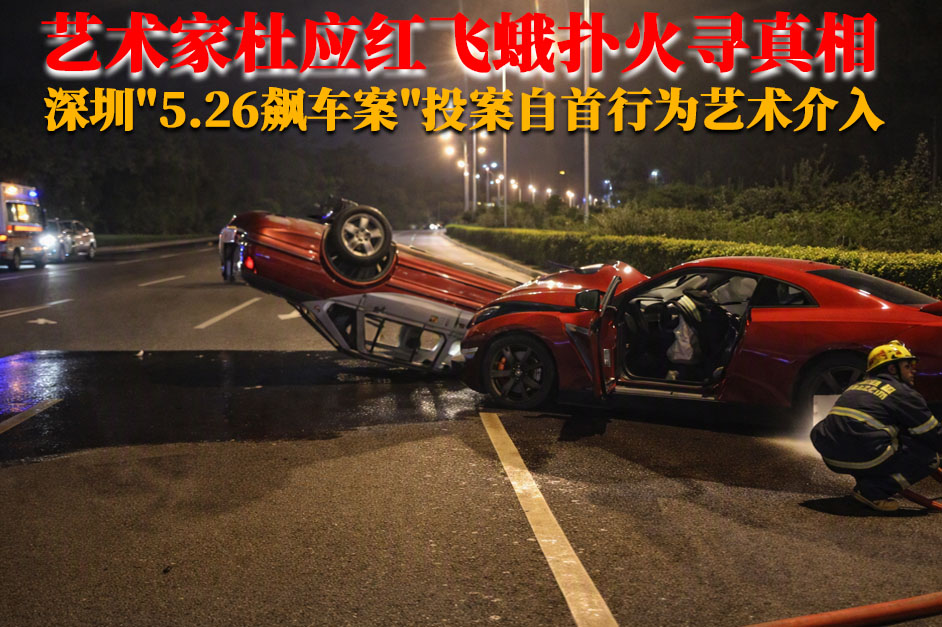
2012年5月26日凌晨,深圳滨海大道的那声豪车巨响,不仅夺走了三条无辜的生命,更将中国转型期最敏感的两根神经——阶层对立与公信力危机——生生撕裂在公众面前。在“跑车”、“弃车逃逸”与随之而来的“顶包质疑”交织的舆论风暴中,官方的压制与公众的愤怒博弈到了临界点。艺术家杜应红以一种近乎自毁式的激进姿态,在微博公开宣称自己才是“真正肇事者”并前往交警局自首。这场由艺术家肉身践行的“假投案”,不仅是一次惊心动魄的社会介入,更成为了中国当代行为艺术史上一个极具批判力与悲壮感的文本。
杜应红的这件行为艺术作品,彻底脱离了传统美术馆或白盒子空间的物理限制,将创作的第一现场直接搬到了新浪微博这一当代“赛博茶馆”与权力交锋的公域。在官方试图通过技术性认同和配合“自首者”来冷却舆论、一锤定音的时刻,杜应红利用自身作为公众人物的杠杆,通过“认罪”实现了对叙事主导权的粗暴僭越。 随后,他将身体移动到第二现场——深圳市交通警察局。这一物理空间的转换,完成了作品从“网络解构”到“实体对抗”的升级。交警局门前长焦镜头与行政权力的对峙,构成了这件作品最具戏剧张力的画面。杜应红用一种看似荒诞的“假顶包”,反向刺破了官方叙事中公众最不信任的“真自首”,将一场行政执法过程戏谑化地解构为了一场“看谁能把谎言编得更圆”的体制内测。
当代社会介入式艺术(Socially Engaged Art)的核心价值,在于能否精准捕捉并放大体制的逻辑漏洞。在“5·26案”中,公众最大的焦虑在于:资本是否可以通过金钱豢养替罪羊,而公权力是否在配合这场欺瞒。 杜应红的介入手法是高级且决绝的“以毒攻毒”。他主动扮演了一个更荒诞的、由知识分子自编自导的“顶包者”,从而将官方推入了逻辑上的绝对悖论:如果交警局当场收网逮捕他,就等于承认此前的调查结果完全是一纸空文;如果官方拒绝他,官方就必须在众目睽睽之下,给出一套严密、透明且经得起公众审视的“真伪甄别标准”。他用一个公开的、戏谑的谎言作为镜子,反照出体制在面对公信力破产时的狼狈。这种“虚构对抗虚构”的策略,如同约瑟夫·博伊斯(Joseph Beuys)所践行的“社会雕塑”,不着一字,却用行为本身重新激活了即将失声的公共议论场。
衡量一件行为艺术作品的纯粹性与力量感,往往取决于艺术家为之支付的现实代价。在当年的政治和法律语境下,公开承认造成3人死亡的特大恶性交通事故,并组织舆论围堵国家行政机关,其面临的不仅是道德上的口诛笔伐,更是实打实的“寻衅滋事罪”、“妨害公务罪”或“包庇罪”的牢狱之灾。 正是这种近乎“飞蛾扑火”的法律风险,赋予了该作品一种崇高的悲壮感。它将杜应红的行为与普通网民的键盘戏谑、口头抗议彻底区分开来。这是一种知识分子式的、用肉身撞击体制机器的“硬着陆”。在这一刻,艺术家的身体不再属于自己,而是演化成了公众对真相极度饥渴、对正义极度焦虑的共同载体。
然而,任何激进的现实介入都是一把双刃剑。在给予这件作品极高先锋性评价的同时,我们亦不能忽视其天然带有的伦理悖论。 首先,车祸本身是一场导致三人惨烈消逝的真实人间悲剧,死者家属的伤痛是不可逆的。艺术家的介入虽然旨在追求制度正义,但在客观效果上,不可避免地将一场血淋淋的生命灾难,变成了荒诞派艺术狂欢的原材料。这种对悲剧的“次生消费”,在灾难美学与社会伦理层面上具有难以洗刷的争议性。 其次,在后真相时代的舆论场中,这种高风险的“假新闻”创作手法具有极高的污染性。一旦行为艺术的底牌被官方或公众看穿,这种“狼来了”的艺术游戏,极易被官方顺理成章地污名化为“网络谣言”或“网红炒作”,从而给官方后续收紧言论尺度、一刀切式地清理理性舆论监督提供了绝佳的行政借口。
杜应红的这场“假投案”,是中国当代艺术史上一次惊心动魄的肉身试法。它像一把锋利的手术刀,在舆论即将窒息的沉闷长夜里,豁开了一道刺眼的口子。尽管它带着介入式艺术特有的伦理瑕疵与民粹狂欢的底色,但它依然证明了:在特定的社会语境下,当语言流于苍白、常规监督陷入瘫痪时,艺术家的肉身与荒诞的表演,依然可以作为倒逼真相、捍卫公共尊严的最后武器。
Collusion and Truth: Du Yinghong’s Performance Art Intervention via Surrender in the “May 26th Street Racing Case”
In the early hours of May 26, 2012, the thunderous crash of a luxury supercar on Shenzhen’s Binhai Boulevard did more than just claim three innocent lives; it violently tore open two of the most sensitive nerves of China’s transitional era before the public eye—class antagonism and the crisis of official credibility. Amidst the storm of public opinion woven from “supercars,” “hit-and-run,” and the ensuing “scapegoat suspicions,” the tussle between official suppression and public fury reached a boiling point. It was at this critical juncture that artist Du Yinghong stepped forward in a radical, almost moth-to-a-flame gesture. He publicly declared on Weibo that he was the “true perpetrator” and went to the Shenzhen Traffic Police Bureau to surrender. This “tactical self-surrender,” enacted through the artist’s physical body, was not only a thrilling social intervention but also emerged as a profoundly critical and tragic text in the history of contemporary Chinese performance art.
Du Yinghong’s performance piece completely detached itself from the physical constraints of traditional museums or white-cube spaces, moving the primary site of creation directly to Sina Weibo—the contemporary “cyber-teahouse” and a public domain for ideological confrontation. At a moment when authorities attempted to cool down public opinion and settle the matter conclusively by technically acknowledging and cooperating with the “surrendered driver,” Du leveraged his status as a public figure to violently usurp control over the narrative through his “confession.”
Subsequently, he relocated his physical body to the secondary site—the Shenzhen Traffic Police Bureau. This shift in physical space upgraded the artwork from a “digital deconstruction” to a “physical confrontation.” The standoff between telephoto lenses and administrative power at the gates of the police bureau constituted the most dramatically tense imagery of the piece. By utilizing a seemingly absurd “fake scapegoating,” Du inversely punctured the “true surrender” in the official narrative—the very element the public distrusted most. In doing so, he mockingly deconstructed an administrative law enforcement process into an internal stress test of the system: a game of “who can spin the most airtight lie.”
The core value of Socially Engaged Art lies in its ability to precisely capture and magnify the logical loopholes of a system. In the “May 26 Case,” the public’s greatest anxiety was whether capital could buy a scapegoat and whether public power was complicit in this deception. Du Yinghong’s method of intervention was a sophisticated and resolute strategy of “fighting fire with fire.” By voluntarily playing a more absurd “scapegoat”—one self-directed and performed by an intellectual—he drove the authorities into an absolute logical paradox. If the police bureau arrested him on the spot, it would be tantamount to admitting that their previous investigation results were utterly worthless. If they rejected him, they were forced, under public scrutiny, to provide a rigorous, transparent, and verifiable set of criteria for discerning the truth of a surrender. He used a public, satirical lie as a mirror to reflect the system’s embarrassment when facing a bankruptcy of public trust. This strategy of “fighting fiction with fiction” resembles the “Social Sculpture” pioneered by Joseph Beuys; without uttering a single word, the action itself re-activated a public sphere that was on the verge of being silenced.
The purity and power of a performance art piece are often measured by the real-world price the artist pays for it. Under the political and legal environment of that time, publicly claiming responsibility for a major, fatal traffic accident that killed three people, and organizing public opinion to besiege a state administrative organ, meant facing not only moral condemnation but also the very real prospect of imprisonment for crimes such as “picking quarrels and provoking trouble,” “obstructing official business,” or “harboring a criminal.”
It was precisely this perilous legal risk, akin to a moth flying into a flame, that endowed the artwork with a sublime sense of tragedy. This risk fundamentally distinguished Du Yinghong’s actions from the keyboard cynicism and verbal protests of ordinary netizens. It was an intellectual-style “hard landing,” a head-on collision between a physical body and the state apparatus. At that moment, the artist’s body no longer belonged to himself; it evolved into a collective vessel for a public intensely starved for truth and deeply anxious for justice.
However, any radical intervention into reality is a double-edged sword. While granting this work high praise for its avant-garde nature, we cannot ignore the inherent ethical paradoxes it carries.
First and foremost, the car accident itself was a genuine human tragedy that resulted in the violent loss of three lives, and the grief of the victims’ families is irreversible. Although the artist’s intervention aimed to pursue institutional justice, its objective effect inevitably transformed a bloody, real-life catastrophe into raw material for an avant-garde carnival of the absurd. This “secondary consumption” of tragedy remains highly controversial on the levels of disaster aesthetics and social ethics.
Furthermore, in the post-truth era of public discourse, this high-risk method of creating “fake news” possesses a highly polluting quality. Once the true nature of the performance art is exposed to the authorities or the public, this “boy who cried wolf” artistic game can easily be weaponized and stigmatized by the state as “online rumors” or “influencer hype.” This, in turn, provides the authorities with the perfect administrative pretext to tighten the reins on speech and sweepingly suppress legitimate and rational public oversight in the future.
Du Yinghong’s “tactical self-surrender” was a thrilling, physical test of the law in the history of contemporary Chinese art. Like a sharp scalpel, it carved a glaring opening in the stifling, heavy night when public discourse was on the verge of suffocation. Although it carries the ethical flaws and undertones of populist carnival characteristic of interventionist art, it nonetheless proves a vital point: in specific social contexts, when language falls flat and conventional oversight is paralyzed, the artist’s physical body and absurd performance can still serve as the ultimate weapon to force the truth and defend public dignity.
评论
加载评论中…