流动的都市暗疮与景观的逆转:评杜应红《城市花车》的媒介反思与空间干预
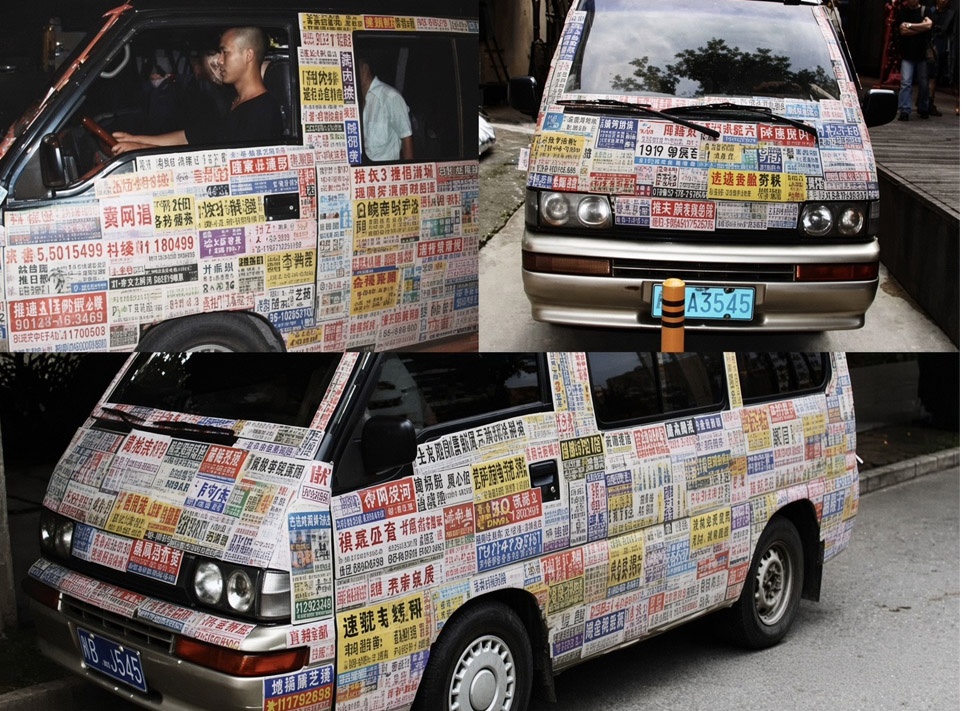
2005年的深圳,正处于狂飙突进的城市化浪潮之中,官方叙事极力向世界展示一个干净、绿化、秩序井然的“国际花园城市”橱窗。然而,在这座现代化样板房的肌理之下,由办证、迷药、高利贷、涉黄等非法街头广告构成的“城市牛皮癣”,如同挥之不去的暗流,在小巷与电线杆上野蛮生长。艺术家杜应红以一种极具黑色幽默与介入感的姿态,通过“清理街道、包裹私车”的反向操作,创作了装置行为艺术作品《城市花车》。这辆在深圳街头流动的面包车,不仅是一次精妙的现成物重组,更成为了千禧年过后中国当代社会介入艺术史上的一份带着痛感的社会学诊断报告。
《城市花车》最直观的艺术成就,在于其对低俗现成物(Readymade)的符号学重组与媒介解构。在日常语境中,街头小广告是一种具有空间侵略性和视觉污染性的“社会垃圾”,它们代表着法律与行政管控之外的地下欲望与生存挣扎。
杜应红的创作展现了一种激进的“情境主义逆转”(Détournement)。他通过物理层面的收集与严丝合缝的拼贴,将这些原本散落在公共空间、让人避之不及的“都市暗疮”,转化为自己面包车的“艺术皮肤”。这种从垃圾到艺术品的质变,不仅打破了传统艺术品对高雅材质的垄断,更完成了一次视觉暴力的文化挪用(Appropriation)。原本刺眼、零碎的非法信息,在被密集排布于车体表面后,异化为了一种具有波普艺术(Pop Art)质感的荒诞图腾,将底层的生存阵痛转译为了极具视觉冲击力的先锋文本。
这件作品的深刻性,恰恰在于它彻底脱离了美术馆“白盒子”空间的庇护与规训,将其置于现代都市的流动性(Mobility)之中。这辆面包车不是一件静止的雕塑,而是一个具有空间穿透力的移动景观(Mobile Landscape)。
居伊·德波在《景观社会》中指出,现代社会表现为一种被精心组织起来的“伪造景观”。2005年前后的深圳官方正致力于构建一种无瑕疵的现代化中产阶级景观,而杜应红的《城市花车》则成为了这一“神话”的祛魅者。当这辆贴满荒诞契约与非法欲望的面包车在主干道、商业区和居民区穿行、停泊时,它像一面流动的镜子,走到哪里,就把城市试图掩盖的“背面”反射到哪里。这种本土生长、本土反噬的生态闭环,直接对冲了宏大叙事下的市容规规训,让行政权力在面对这种“流动的艺术合法性”时,陷入了前所未有的管理尴尬与失语。
杜应红在作品中提出的“物理环保”与“精神环保”概念,精准地切中了转型期商业社会的人类生存困境。
在物理层面,艺术家用个体劳作的方式“清洁城市”,是一次具有微型乌托邦色彩的社会实践,它用个体的微小抵抗修正了宏大城市管理中的粗暴遗漏。而在更深的精神层面,这件作品则是一次深刻的社会病理学诊断。这些牛皮癣广告的本质,是现代消费主义和资本原始积累时期泛滥的欲望投射。杜应红将这些“欲望的病灶”全盘转移并承载于自身的私产之上,完成了一种圣徒式的“代人受过”或“毒素吸纳”。它迫使每一个与这辆车擦肩而过的都市人去反思:当钢筋水泥的物理空间被清洗得日益洁净、反光时,现代人的精神空间是否正被泛滥的欲望和地下资本的恶之花彻底异化?
《城市花车》是中国当代“社会介入式艺术”(Socially Engaged Art)在特定历史转型期的本土高光之作。杜应红巧妙地利用了现代商业社会的“流动工具”(面包车)来对抗现代城市的“规训空间”。这辆承载着非法欲望与荒诞图景的面包车在深圳的行走与存在,不仅是一次成功的观念实验,更成为了一座流动的纪念碑,铭刻下了中国城市化进程中最真实、最生猛也最不该被遗忘的时代切片。
Mobile Urban Blemishes and the Reversal of Spectacle: Media Reflection and Spatial Intervention in Du Yinghong’s Urban Float
In 2005, Shenzhen was riding the wave of wild, rapid urbanization, with official narratives doing their utmost to present a flawless showcase of a clean, green, and orderly “International Garden City” to the world. Yet beneath the veneer of this modern showpiece, “urban psoriasis”—comprising illegal street advertisements for forged certificates, knock-out drugs, usury, and illicit sex services—functioned as a persistent undercurrent, growing wildly on utility poles and back alleys. With a keen sense of black humor and interventionism, artist Du Yinghong executed a reverse operation of “cleaning the streets to wrap a private vehicle,” creating the installation and performance art piece Urban Float. This minivan, circulating through the streets of Shenzhen, was not only a brilliant reassembly of the readymade but also emerged as a painfully poignant sociological diagnostic report in the history of post-millennial Chinese socially engaged art.
The most immediate artistic achievement of Urban Float lies in its semiotic reassembly and media deconstruction of vulgar readymades. In everyday contexts, street flyers constitute a form of spatial aggression and visual pollution—social trash representing underground desires and survival struggles outside the bounds of law and administrative control.Du Yinghong’s creation demonstrates a radical “Situationist Detournement” (Détournement). Through physical collection and seamless collage, he transformed these “urban ulcers,” which people usually avoided at all costs in public spaces, into the “artistic skin” of his own minivan. This qualitative mutation from garbage to artwork not only shattered the monopoly of traditional art objects over refined materials but also accomplished a cultural appropriation of visual violence. The originally glaring and fragmented illicit information, once densely arranged across the vehicle’s body, mutated into an absurd totem possessing a Pop Art texture, translating the survival pains of the lower strata into a highly impactful avant-garde text.
The profundity of this work lies precisely in its total departure from the protection and discipline of the traditional museum “white cube,” plunging instead directly into the mobility of the modern metropolis. This minivan is not a static sculpture but a mobile landscape endowed with spatial penetration. In The Society of the Spectacle, Guy Debord points out that modern society manifests as an elaborately organized “fabricated spectacle.” Around 2005, the Shenzhen authorities were dedicated to constructing a flawless, modern, middle-class spectacle. Du Yinghong’s Urban Float acted as the demystifier of this “myth.” As this minivan, laden with absurd pacts and illegal desires, cruised and parked across main avenues, commercial districts, and residential neighborhoods, it functioned as a moving mirror—reflecting the “hidden back” of the city wherever it went. This closed ecological loop, locally grown and locally disruptive, directly countered the urban discipline of the grand narrative, trapping administrative power in an unprecedented state of managerial embarrassment and speechlessness when faced with this “mobile artistic legitimacy.”
The concepts of “physical environmentalism” and “spiritual environmentalism” put forward by Du Yinghong in this work precisely capture the human predicament within a transitional commercial society. On the physical level, the artist’s individual labor to “clean the city” represents a social practice tinged with a micro-utopian hue; it uses micro-resistance to correct the crude omissions of macro-urban management. On a deeper spiritual level, the work serves as a profound diagnosis of social psychopathology. The essence of these street ads is a projection of the rampant desires bred during a period of consumerism and primitive capital accumulation. By shifting and absorbing these “pathological clusters of desire” entirely onto his private property, Du Yinghong achieved a saint-like “vicarious suffering” or “toxin absorption.” It forces every urbanite who brushes past the vehicle to reflect: as concrete and steel physical spaces are scrubbed increasingly pristine and reflective, are the spiritual spaces of modern humans being completely alienated by rampant desires and the evil flowers of underground capital?
Urban Float stands as a brilliant homegrown masterpiece of Chinese Socially Engaged Art during a specific historical transition. Du Yinghong ingeniously utilized a “mobile tool” of modern commercial society (a minivan) to counter the “disciplining spaces” of the modern city. The movement and presence of this minivan, bearing illegal desires and absurd visions through Shenzhen, was not just a successful conceptual experiment; it became a mobile monument, etching a highly authentic, raw, and unforgettable slice of the era within the process of China’s urbanization.
评论
加载评论中…