破壳而出的新芽与制度的肉身重塑:杜应红《种蛋》的生命政治学与体制突围
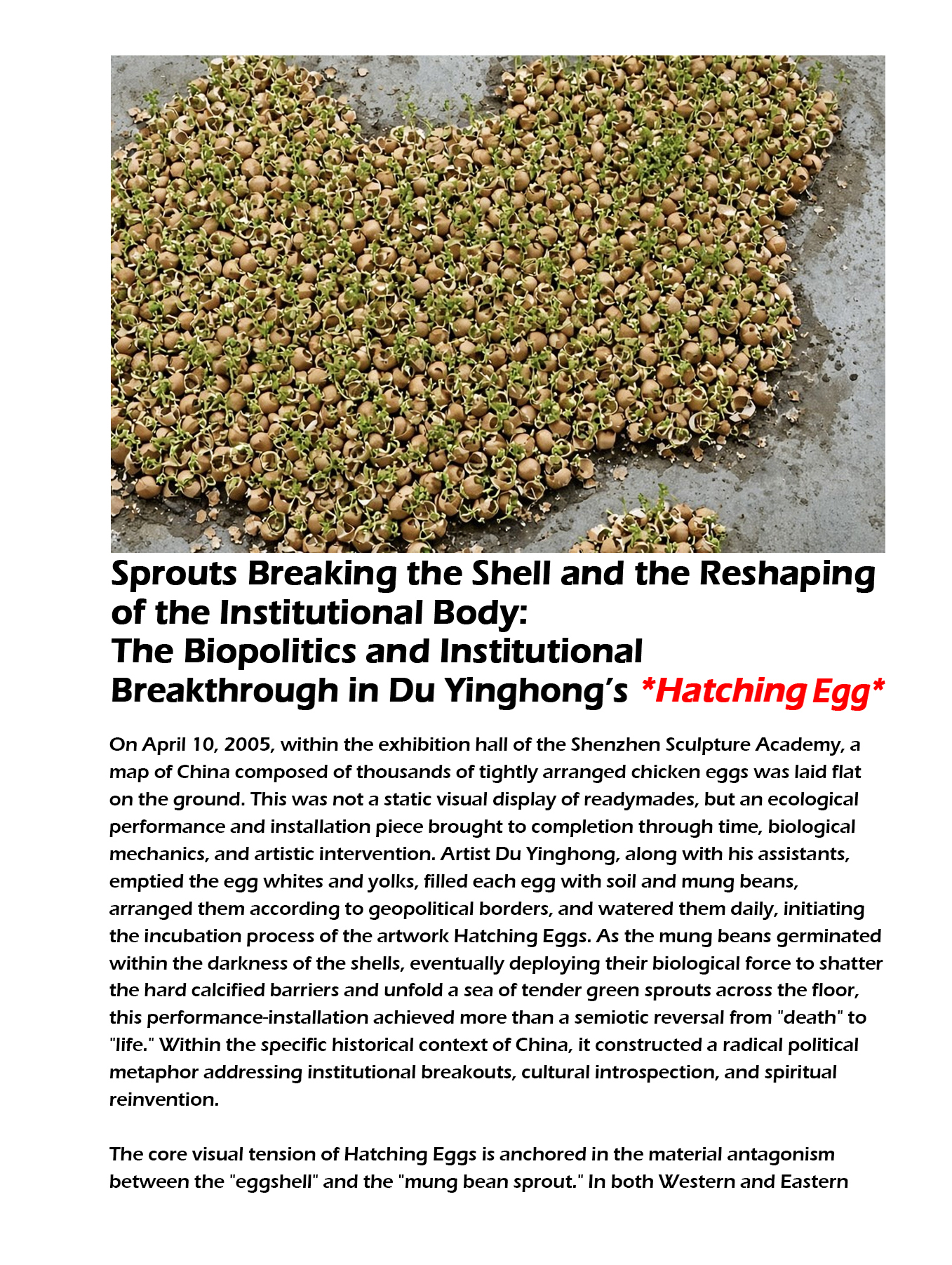
2005年4月10日,在深圳雕塑院的艺术展厅内,一幅由数千枚鸡蛋严丝合缝铺就而成的中国地图平铺于地。这并非一场静态的现成物视觉景观展示,而是一场由时间、生命机能与艺术干预共同完成的生态行为艺术。艺术家杜应红及其助手通过倒空蛋清、注入泥沙与绿豆、按地理边界排布并每日浇水的方式,完成了作品《种蛋》的生命孵化过程。当绿豆在蛋壳的黑暗中破土发育,最终以肉身的力量撑破坚硬的蛋壳、舒展出满地嫩绿的新芽时,这场行为装置艺术不仅完成了从“死亡符号”到“生命图景”的逆转,更在中国特定的历史语境下,构成了一幅关于体制突围、文化反思与精神重塑的激进政治隐喻。
《种蛋》的核心视觉张力,建立在“蛋壳”与“绿豆新芽”这两层物质媒介的对抗之上。在西方及东方传统文化中,“蛋”往往隐喻着混沌、初始的母体,同时也象征着某种封闭、完备却脆弱的边界。在这件作品中,被掏空了蛋清与蛋黄的数千个空蛋壳,成为了中国传统农业社会残留的旧思想、旧文化,以及共产主义制度下宏大、僵化且整齐划一的“制度肉身”的视觉通项。
然而,杜应红并未任由这些蛋壳走向腐烂与虚无,而是将生命意志(绿豆)反向注入其中。绿豆在此处具备了双重隐喻:它既代表着每一个在庞大体制机器下被规训、被原子化的具体个人,也代表着不可遏制的个体觉醒与启蒙思想。当水份渗入泥沙,微小的种子在黑暗、压抑的蛋壳内部开始膨胀、分裂、积蓄能量,这一物理过程在艺术层面被升华为一场生动的生命政治学(Biopolitics)实践。旧的身体被注入了新的基因,个体的生命机能开始复苏,并在体制的绝对包裹中进行着悄无声息的“在地抗争”。
作品最具批判力与视觉震撼感的阶段,在于“破壳”的发生。绿豆芽的生长是一场无声的暴动,数千颗种子的群体性发育,将原本死气沉沉、呈现土褐色的中国地缘版图,逐渐雕塑为一片充满流动性与破坏力的绿色景观。
这种“破壳”是一次对文化与制度牢笼的硬着陆式突围。蛋壳的坚硬代表着体制规训与传统思想的顽固与不可撼动,而嫩芽的柔软则代表着生命与自由的天然合法性。当柔弱的嫩芽以不可逆转的生长力量,在群体性的共振中彻底将坚硬的蛋壳撑开、撕裂、粉碎时,杜应红完成了一次天才般的结构隐喻:消解并摧毁一个庞大、僵化的压迫性体制,往往不需要外在的宏大撞击,而取决于内部每一个具体生命个体自我觉醒后所爆发出的、不可遏制的内在生长力。 这种由内而外的破碎,既是对旧思想“自毁式”的清洗,也是新生命“分娩式”的礼赞。
《种蛋》将展出的舞台严格限定在由泥土铺就的“中国地图”边界之内,这一空间策略让作品具有了强烈的地缘政治色彩。地图作为一个宏大的国家主义政治图腾,代表着疆域、权力和集体意志;而鸡蛋和绿豆则是日常生活中最微不足道的底层现成物。
杜应红借用了约瑟夫·博伊斯(Joseph Beuys)“社会雕塑”的概念,将国家宏大叙事进行了微观尺度的解构。每一个中国人(绿豆)都不再是地图上冰冷的地理坐标,而是正在破壳、正在振作、正在追求精神排毒与重生的活体组织。随着时间的推移,嫩芽野蛮生长、越过蛋壳的碎片、交织在一起,原本清晰、僵硬的省份与地缘边界在绿色的生命浪潮中变得模糊且充满生机。这喻示着:当每一个体的旧思想被洗涤、新身体被激活时,原本带有压迫性的宏大体制边界终将被富有温度、自由联结的公民社会与现代文明生态所取代。
时隔多年回看《种蛋》,它依然是中国当代行为艺术中一记响亮的警钟。杜应红以大地的泥土为纸,以数千枚鸡蛋为墨,用时间的跨度与生命的代谢完成了一次关于“启蒙与突围”的观念书写。
作品虽然带着那个时代特有的宏大政治批判期许与浪漫主义的民粹底色,但其核心传递出的艺术哲思却跨越了时代:在任何看似铁板一块、密不透风的旧体制与旧文化牢笼中,只要个体的觉醒之水未曾干涸,生命便会执拗地寻找裂缝;而那场由千万具体肉身共同发起的、破壳而出的新芽狂欢,终将让真相与自由在废墟中开花。
Sprouts Breaking the Shell and the Reshaping of the Institutional Body: The Biopolitics and Institutional Breakthrough in Du Yinghong’s Hatching Egg
On April 10, 2005, within the exhibition hall of the Shenzhen Sculpture Academy, a map of China composed of thousands of tightly arranged chicken eggs was laid flat on the ground. This was not a static visual display of readymades, but an ecological performance and installation piece brought to completion through time, biological mechanics, and artistic intervention. Artist Du Yinghong, along with his assistants, emptied the egg whites and yolks, filled each egg with soil and mung beans, arranged them according to geopolitical borders, and watered them daily, initiating the incubation process of the artwork Hatching Eggs. As the mung beans germinated within the darkness of the shells, eventually deploying their biological force to shatter the hard calcified barriers and unfold a sea of tender green sprouts across the floor, this performance-installation achieved more than a semiotic reversal from “death” to “life.” Within the specific historical context of China, it constructed a radical political metaphor addressing institutional breakouts, cultural introspection, and spiritual reinvention.
The core visual tension of Hatching Eggs is anchored in the material antagonism between the “eggshell” and the “mung bean sprout.” In both Western and Eastern traditional cultures, the “egg” serves as a metaphor for chaos, primordial origin, and an enclosed, self-contained, yet fragile boundary. In this piece, the thousands of hollow eggshells—emptied of their vital nutrients—function as a visual denominator for the residual archaic ideologies of China’s traditional agrarian society, as well as the grand, rigid, and homogenized “institutional body” under the communist system.
However, rather than abandoning these shells to rot and vanish into nothingness, Du Yinghong conversely injected vital life force (the mung beans) into them. The mung bean serves a dual metaphor here: it represents the concrete individual who has been disciplined and atomized under a colossal institutional machine, while simultaneously signifying the unstoppable awakening of the self and the rise of enlightenment thought. As water permeated the soil, the microscopic seeds began to swell, split, and accumulate energy within the dark, suffocating interiors of the shells. This physical process was elevated into a vivid practice of Biopolitics at the artistic level. The old body was infused with a new genetic code; individual biological functions began to revive, staging a quiet, localized resistance (in-situ resistance) within the absolute containment of the institution.
The most critical and visually staggering phase of the artwork manifested in the occurrence of “hatching.” The growth of the mung bean sprouts was a silent mutiny. The collective development of thousands of seeds gradually sculpted the once lifeless, soil-brown geopolitical map into a fluid and destructive green landscape.
This “shattering of the shell” represents a head-on, hard-landing breakout from cultural and institutional cages. The hardness of the eggshell denotes the stubborn, immovable nature of institutional discipline and traditional ideology, while the softness of the sprout embodies the natural legitimacy of life and freedom. When the tender sprouts, fueled by irreversible growth, completely cracked, tore, and pulverized the hard shells through collective resonance, Du achieved a stroke of genius in structural metaphor: the dismantling and destruction of a massive, rigid, and oppressive institution does not rely on a colossal external impact; instead, it hinges on the uncontainable internal growth triggered by the self-awakening of every concrete individual. This internal-outward rupture serves both as a self-destructive purging of obsolete ideas and a parturient celebration of new life.
By strictly confining the stage of the exhibition within the boundaries of a “Map of China” shaped from local soil, Du Yinghong infused the artwork with a strong geopolitical hue. The map, as a grand nationalist political totem, signifies territory, power, and collective will, whereas eggs and mung beans are the most trivial grassroots readymades of daily life.
Borrowing Joseph Beuys’s concept of “Social Sculpture,” Du Yinghong deconstructed the grand national narrative on a micro-scale. Every Chinese citizen (the mung bean) was no longer a cold geographical coordinate on a map, but a living tissue hatching, shaking off torpor, and pursuing spiritual detoxification and rebirth. Over time, as the sprouts grew wildly, transcending the shards of eggshell and intertwining with one another, the once rigid and clear provincial borders blurred and dissolved into a vibrant wave of green. This implies that when the old ideas of each individual are cleansed and their new bodies are activated, the once oppressive, macro-institutional boundaries will ultimately be replaced by a warm, freely associated civil society and a modern civilized ecosystem.
Looking back at Hatching Eggs after all these years, it remains a resounding alarm in the history of contemporary Chinese performance art. Du Yinghong used the earth’s soil as his paper and thousands of eggs as his ink, utilizing the span of time and biological metabolism to script a conceptual narrative of “enlightenment and breakout.”
Although the work bears the grand political criticism and romantic populist undertones characteristic of its era, the core artistic philosophy it transmits transcends time: in any seemingly monolithic, airtight old system or cultural cage, as long as the water of individual awakening does not dry up, life will stubbornly find a crack. Ultimately, the carnival of new sprouts breaking through their shells, initiated collectively by millions of concrete flesh-and-blood individuals, will force truth and freedom to blossom amidst the ruins.
评论
加载评论中…